Showing posts with label hockey. Show all posts

Saturday, March 30, 2013

Three Periods: Flames fumbled Jarome Iginla for years; Sharks test trade waters; 'Canes comfy with Alex Semin gamble

FIRST PERIOD: Flames fiddled around with Jarome Iginla for far too long


Former Flames captain Jarome Iginla at his farewell press conference in Calgary. (Reuters)


The Calgary Flames should be embarrassed. Deeply, deeply embarrassed. Because this goes beyond the obvious – that they waited far too long to trade captain and icon Jarome Iginla, that they let one team believe a deal was done only to have him waive his no-trade clause for another team, that they got far too little in return. Let’s not lose sight of why they had to trade Iginla in the first place.

This has been a misguided and mismanaged franchise for years, and it certainly didn’t start with current general manager Jay Feaster, who presided over this shortly after the Ryan O’Reilly offer sheet fiasco. The blame reaches back to former GM Darryl Sutter – which has to just burn Flames fans, who watched him come out of his Alberta exile last season and win the Stanley Cup as coach of the Los Angeles Kings. It extends to team president Ken King and up to chairman Murray Edwards.

Bad drafts. Bad trades. Bad signings. Bad decisions in so many areas for so many years. The Flames didn’t just waste Jarome Iginla as an asset. They wasted Jarome Iginla as a player. A good organization would have recognized reality – that this was not a playoff team, let alone a potential Cup contender – and would have moved Iginla long ago in a smart way to start the rebuild. A better organization wouldn’t have had to move Iginla at all because it would have actually built a playoff team around him.


Iginla had a no-trade clause and was close to Edwards. He loved Calgary and was beloved by Calgary. Maybe he was just as delusional and stubborn as management, and maybe all that made him more difficult to trade. At a news conference Thursday, he wouldn’t rule out coming back to the Flames, saying: “I think the organization is going in the right direction.” He slipped and still called the Flames “we.”

But it was not Iginla’s job to make tough decisions, and it was not his job to surround himself with talent. It was his job to lead and perform, and his loyalty and class helped make him more than just a star player. He did his part even as he aged and his teammates struggled, all his numbers going for naught.

Iginla scored 32 goals at age 32 in 2009-10, when the Flames didn’t make the playoffs. He scored 43 goals at age 33 in 2010-11, when the Flames didn’t make the playoffs. He scored 32 goals at age 34 last season, when the Flames didn’t make the playoffs. And he has nine goals in 31 games at age 35 this season – a 22-goal pace over an 82-game schedule – with the Flames out of playoff position yet again.

Had the Flames decided to trade Iginla a year or two ago, they could have done this the right way. They could have worked with Iginla to create a market that would reap a decent return, and theoretically the assets they acquired would be paying dividends by now. It would have been brutal, but it could have been dignified and productive. Most fans and media would have understood. Many were calling for it.


By waiting, they ended up stuck – under pressure to do something with Iginla on an expiring contract, with Iginla in control because of his no-trade clause. The Boston Bruins offered the best deal, even if it wasn’t great, and the Flames agreed to it. But Iginla picked the Pittsburgh Penguins, who offered even less than the Bruins did, and so the Flames had to accept only a late first-rounder and what experts consider two C-list college prospects. They are not going to start a rebuild with that.

But worst of all, by managing the team so poorly after their run to the Cup final in 2004, they squandered the back end of Iginla’s prime and made their captain the subject of trade rumors for years, testing his character in all sorts of uncomfortable situations.

Could they have refused to trade Iginla to Pittsburgh and tried to force him to Boston to get the best return? Could they have refused to trade him at all? Maybe. But they’re the ones who gave him the no-trade clause, they’re the ones who put him in this position, and they’re the ones who would have looked classless, not just clueless, had they tried to play hardball. And what if they alienated him so much that he left for nothing as a free agent?

Failure begets failure. Even though the Flames have finally recognized the need to rebuild and finally traded Jarome Iginla, there is no reason to believe they are about to break the cycle. Their future looks as bleak as ever.

They’re lucky Iginla wanted to stay for so long. It’s incredible he won’t rule out coming back. You’d think it would have been Iginla asking for a trade, not the other way around.

SECOND PERIOD: Sharks test the water ahead of NHL trade deadline


The Sharks have some big decisions on the eve of the NHL trade deadline. (Getty)


Listen to what San Jose Sharks GM Doug Wilson said Monday after trading defenseman Douglas Murray to the Penguins: “Can it lead to other deals? Sure, it can. There are certainly a lot of teams that are in contact with us.”

Wilson said it was “not acceptable” how the Sharks had played after their 7-0-0 start, and he made it clear that their performance before the trade deadline would have a great impact on what he decided to do.

“They’re all big boys,” Wilson said. “They know what’s on the line here. To me, actions speak louder than words. Play well. Let us know where you’re at with your game. … I’d like to see us over the next little while in particular step up our game. There’s no reason why we can’t.”

Well, look what has happened since: The Sharks have won back-to-back games over the Anaheim Ducks, the second-ranked team in the Western Conference. They won on the road, and they won at home. They won by a combined score of 8-3, when their biggest issue has been a lack of offense.

So now what? Should Wilson read too much into that, considering the Ducks have now lost four straight?

The Sharks entered Thursday night in eighth place in the West. They had three more games before the deadline – Thursday night against the Detroit Red Wings, Saturday night against the Phoenix Coyotes and Monday night against the Vancouver Canucks, all at home.

Can they show Wilson enough to keep this group together?

Change is coming, whether it’s now or in the near future. Veteran forwards Ryane Clowe and Michal Handzus, who have combined for only one goal this season, are pending unrestricted free agents. Veteran stars Joe Thornton, Patrick Marleau and Dan Boyle all have one year left on their contracts. By design.

“We knew that this window would be getting here, or this time, if you look at how our contracts are structured, what we have in committed dollars,” Wilson said. “We don’t use the world ‘rebuild,’ because that classically means six, seven years. … We like to use the term of ‘reset and refresh.’ ”


The Sharks have players to reset and refresh around: Antti Niemi in goal; Brent Burns on defense, when he’s not moonlighting at forward; Logan Couture and Joe Pavelski up front. But now might be the time to part with players like Clowe and Boyle, and they need to make decisions soon on players like Thornton and Marleau, the two who have been cornerstones.

Wilson supported coach Todd McLellan and his staff. He said the coaches have addressed the areas management wanted – penalty killing, goals against, play around the net. When the Sharks play the way they’re supposed to, they play well. But they have struggled to score and perform consistently.

“Do I think that’s coaching preparation? No,” Wilson said. “I think it comes down to players sticking with it, not altering our approach to a game just because we’re down a goal or whatever. … The offensive side, it’s hard to fathom. We’ve got some guys that have been goal-scorers in this league that all went dry at the same time, or guys that were scoring at a very high clip before …”

He did not finish his sentence. He did not identify Marleau, who scored nine goals in his first five games but has seven since. He didn’t need to.

“This is coming to crunch time,” Wilson said. “We’ve had some inconsistency. If you look at any teams that have separated themselves from the pack, they’ve played by committee. They’ve played strong defense. They’ve created some offense and played a consistent approach to it. We haven’t done that. We need to do that now. …

“We have a pretty clear, concise plan. We knew as we were entering into this timeframe – whether it be now or this summer – exactly how we were going to execute that plan, and I guess the timing is dictated by performance.”

THIRD PERIOD: Carolina comfortable with all-in gamble on enigmatic Alex Semin


Alex Semin didn't take long to convince Carolina that he was worth the risk of a long-term deal. (USA Today)

Jim Rutherford understands your skepticism.

Alex Semin signed three straight one-year contracts – two with the Washington Capitals, then one with the Carolina Hurricanes. He is known for offensive production, but not for showing up every night.

Yet after only 30 games with the ’Canes, less than half a full season, Rutherford, a GM who used to avoid in-season extensions, gave Semin a five-year, $35 million contract.

And he did so knowing full well how difficult it will be to fit a $7 million cap hit into his budget, not just because the cap will come down to $64.3 million next season, but because Carolina doesn’t spend to the cap, anyway.

“I’ve added seven million to our payroll next year,” said Rutherford, who put Jussi Jokinen on waivers this week, hoping someone would take his $3 million cap hit for the rest of this season and next, only to watch him clear. “I’ve got to start to figure out ways that we can get our payroll in better line with what our business does.”

Let him explain:

The Hurricanes gave Semin a one-year deal initially because they simply didn’t know him. They knew both his ability and his reputation, but they wanted to give him a clean slate. Could he play in their system? Would he like coach Kirk Muller, and would Muller like him?

“When we did the one-year deal, it was with hopes that this would work,” Rutherford said. “And it has worked for us.”

Semin has eight goals and 30 points in 31 games. That’s a 21-goal, 79-point pace for a full 82-game schedule. Just as important, he has boosted the totals of Eric Staal and Jiri Tlusty, giving the Hurricanes an excellent first line. He has clicked with Staal better than anyone since Cory Stillman, Staal’s right winger when the ’Canes won the Cup in 2006.

“Alex gets Eric the puck more than he’s ever gotten it,” Rutherford said.

Semin is also plus-15, even though he was minus-5 over the past three games.

“People view him as an offensive player, but he’s done some things in games defensively that’s saved the game for us,” Rutherford said. “He’s played the game at both ends of the rink.”


But what about the small sample size? Isn’t Rutherford worried Semin will start coasting now that he has security? And why has Rutherford started giving extensions during the season?

“I believe with a player like this, if you wait too long, you could very well miss an opportunity,” Rutherford said. “I can tell you that I’ve had two teams in particular – and I can add another, more in a casual way – that asked if we were going to re-sign Alex or if we would consider trading him.

“So once I get those calls, and there’s other teams thinking about it now, the judgment call becomes more, do you make that decision after 30 games based on what you’ve seen, or do you also factor in how far you can run the risk until you get closer to free agency?”

More teams are locking up their key players, which means fewer key players are reaching the free-agent market, which means they are more difficult to replace. So more teams are locking up their key players, creating a snowball effect.

That’s why Rutherford changed course last year and locked up Tuomo Ruutu, and that’s why he locked up Semin. Had he let Semin hit the market, he likely would have lost him. Had he lost him, he likely would not have found an equivalent replacement. Had he not found an equivalent replacement, what would have happened to his first line?

“I think that if a team decides they want a player – certainly if we decide we want a player – we’re going to jump in and do it before the season’s over instead of waiting now,” Rutherford said, “because it becomes a lot riskier.”

Even riskier than giving Alex Semin a rich, long-term deal.

If only Jarome Iginla were the only issue in Calgary.


Does Miikka Kiprusoff intend to play the final year of his contract? (USA Today)


Defenseman Jay Bouwmeester has a no-trade clause and one year left on his contract at $6.68 million. He could, and should, be asked to go if the Flames can get something decent in return for him.

Goaltender Miikka Kiprusoff does not have a no-trade clause, but he reportedly will retire rather than play the final year of his contract if the Flames try to move him. That’s ostensibly because he and his wife just had a baby.

But Mike Keenan has said the Flames and Kiprusoff had a mutual understanding that he wouldn’t play the last year of his contract, anyway. Keenan was the Flames coach when they signed Kiprusoff to a six-year, $35 million deal with the following structure: $8.5 million, $7 million, $7 million, $6 million, $5 million, $1.5 million.

The last year seems phony, tacked on to lower the cap hit to $5.833 million. That’s why the NHL fought to outlaw back-diving contracts in the new collective bargaining agreement. And Keenan’s comments seem to prove cap circumvention. But will the NHL take action? Probably not, and certainly not at this point.

League officials aren’t naive. It’s likely the Flames and Kiprusoff considered the idea he might retire before the end of his contract. But even though Keenan was their coach then, he is now a media personality and his comments alone aren’t enough to establish a pre-existing agreement that Kiprusoff would not play the last year of the deal. The NHL will at least see what Kiprusoff actually does before exploring it further or making any judgments.

SHOOTOUT: Last shots from around the NHL

— The NHL continues to work on ways to keep the Coyotes in Glendale, Ariz. But the league does not know if any of them will work, and this has been going on for years. Relocation has to be considered. But will the league make a decision before the playoffs? Not necessarily. It depends on the progress that is made – or is not made – in the coming weeks. Deputy commissioner Bill Daly said the NHL’s “current focus remains on selling the Coyotes to ownership in Glendale. We haven’t spent much time on anything else.”


— Eric Staal had 24 goals, 70 points and a minus-20 rating in 82 games last season. He has 14 goals, 35 points and a plus-16 rating in 31 games this season. Three reasons: his own determination to improve, his chemistry with Semin and his brother Jordan’s arrival from Pittsburgh. Eric still faces the toughest matchups as the No. 1 centerman, but Jordan takes a lot of pressure off him as the No. 2. “When you’re rolling two 6-foot-4 centericemen back to back, that gives a guy a comfort level,” Rutherford said. “Jordan’s eating up a lot of minutes. He’s playing over 20 minutes a game, and he’s done a good job for us despite the fact he’s playing with a whole lot of different guys. But we’ll get that straightened out here when we get everybody healthy.”

— Now that the Tampa Bay Lightning has fired coach Guy Boucher, the heat is on GM Steve Yzerman. He has been through struggles before as a player and executive, but this is perhaps the first time he has been singled out and blamed, at least to this degree, for his team’s failures. He might have made a good hire in Jon Cooper, but it remains to be seen whether Cooper is just the next Guy Boucher, a well-regarded, up-and-coming coach with no NHL experience. Like Boucher, Cooper won’t succeed unless Yzerman gives him better goaltending, a more mobile defense and increased scoring depth. One thing about Yzerman, though. He works hard, relishes challenges and never gives up.

Tuesday, March 26, 2013

Ovechkin, Backstrom, Kadri named NHL's 'Three Stars'

By The Sports Xchange | The SportsXchange20 hours ago
The NHL announced Monday that Washington Capitals left wing Alex
Ovechkin, Minnesota Wild goaltender Niklas Backstrom and Toronto Maple
Leafs center Nazem Kadri were named the league's "Three Stars" of the week.
Ovechkin led the league with five goals and eight points in four games. He has scored in five straight games overall. He combined for five points in back-to-back games at the Winnipeg Jets. He had a goal and two assists on Thursday and two goals on Friday.
Ovechkin leads Washington with 16 goals in 32 games and is second with 31 points.
Backstrom went 3-0-0 last week with a 1.00 goals-against average, .972 save percentage and one shutout as the Wild extended their win streak to a season-best five games. He combined for 104 saves over last week's games, including a season-high 36 against the host Detroit Red Wings on Wednesday.
Backstrom is second in the NHL with 16 wins this season with a 2.23 goals-against average and .921 save percentage in 25 games.
Kadri tallied seven points in three games with three goals and four assists. He had a career-best three assists and had a plus-3 rating in a 4-2 win over the Tampa Bay Lightning on Wednesday. He followed that up with two goals and an assist in a 5-4 shootout loss at the Buffalo Sabres on Thursday.
Kadri leads Toronto with 34 points in 32 games. He is tied for the team lead with 14 goals and 20 assists.


Penguins paid dearly for run-down version of Brenden Morrow – and it's the right move

yahoosprts.com


The Pittsburgh Penguins did not trade for Brenden Morrow, at least not the Brenden Morrow we remember. They did not acquire the kid who went to the Stanley Cup final in 2000, the captain who carried his team to the conference final in 2008, the Olympian who won gold in 2010 or the guy who scored 33 goals in 2010-11.


Brenden Morrow had been in Dallas his entire career, arriving the season after the Stars won the Cup in 1999. (USA …


They traded for a player who is 34, an old 34, someone who has racked up the mileage, who has slowed down considerably, who has slipped as low as the fourth line this season. There are legitimate questions about how much this Brenden Morrow has left.

But that’s OK. Even at the price they paid.

Because the Penguins knew what they were getting and what they were giving up, and this is what you do in today’s market to make a run at the Stanley Cup, if you have put yourself in position to do so.

They don’t need a captain or a top scorer; they need a complementary piece to fill a specific role.
They could afford to send defense prospect Joe Morrow, a 2011 first-round pick playing in the minors, to the Dallas Stars for Brenden Morrow, a veteran whose contract is expiring, because they’ve stockpiled young defensemen as assets and have even more where he came from. They also traded a fifth-round pick for a third-rounder.

Frankly, they couldn’t afford not to do it. The Penguins have won only one playoff round since they won the Stanley Cup in 2009. Sidney Crosby is healthy again and the best player in the world again. The team is on a winning streak – 12 games now – and atop the East. When you have a chance to go for it, seize it. This might just be the start.

“As a general manager, it doesn’t make you feel great all the time,” Penguins GM Ray Shero told reporters. “But that’s what we’re trying to do – win.”

Brenden Morrow was done in Dallas. He gave everything he had to the only organization he had ever known, but it was time. It says a lot that the Stars moved their captain while still in a playoff spot.

GM Joe Nieuwendyk, a friend and former teammate, wanted to put Morrow in a good situation while getting a good return. He did that. But it also says a lot that it wasn’t hard to do.

At least one other Stanley Cup contender thought Morrow had value, too. The Boston Bruins reportedly offered defense prospect Alex Khokhlachev, a 2011 second-round pick, plus a second-rounder. Nieuwendyk had his choice. He asked Morrow to waive the no-trade clause to go to Pittsburgh.

So both Shero and the Bruins’ Peter Chiarelli – two GMs who have built championship teams – thought Morrow could still contribute in the right situation. Both thought he was an attractive option, if only because the trade market is so thin with the standings so stacked.

And how could Morrow say no to the Penguins? What better chance could he have to resurrect his career? If he can’t play for Pittsburgh, then he can’t play. If the chance to win his first Cup doesn’t get him going, when he broke into the league a year after the Stars won in 1999, nothing will.

Morrow made more sense for the Penguins than the Calgary Flames’ Jarome Iginla, another longtime captain on an expiring contract expected to waive his no-trade clause. Iginla is the better player at this point, no question. But he is a right winger, and Morrow is a left winger.

The Penguins don’t need a right winger in their top six. They have Pascal Dupuis playing with Crosby in the middle and Chris Kunitz on the left, and that has been the most productive line in the NHL thanks to its chemistry. They have James Neal playing with Evgeni Malkin.


The Pens could afford to part with defense prospect Joe Morrow, a 2011 first-round pick. (USA Today)


What they needed was a left winger on the second line and depth in their bottom six, and Morrow can provide one or the other. He can play with Malkin and Neal, winning battles, digging out pucks, feeding the big guys. He doesn’t need to put up points, but he could just by playing his game with those two. If that doesn’t work, he can play on the third line with Brandon Sutter, helping pin teams in their own end. If that doesn’t work, well, he can add character in the room, and at least the Pens didn’t give up someone off their roster.

Joe Morrow seems like a prize. He’s supposed to be able to skate and shoot. Shero said he would play in the NHL for a long time, and maybe he will. But there is a reason the Penguins were willing and able to give him up in this deal.

It is no secret the Penguins draft young defensemen and stockpile them. Some they keep, like Kris Letang, who has blossomed into a Norris Trophy candidate, and Simon Despres, a promising rookie.

Others they use as trade currency, like, well, Alex Goligoski, the guy they sent to the Stars two years ago for Neal and Matt Niskanen, a deal that now seems lopsided in the Penguins’ favor.

Joe Morrow has been transitioning from junior to pro hockey this season. He was a healthy scratch eight times in the first half of the season in the American Hockey League as the Penguins tore down his defensive game and built it back up again, according to The Hockey News, which rated him as the Penguins’ fourth-best prospect in its latest “Future Watch” issue. Two other defense prospects were rated higher: Olli Maatta and Derrick Pouliot.

How Joe Morrow ranks compared to Olli Matta and Derrick Pouliot really isn’t the point. The point is, the Pens still have other young defensemen in the pipeline, and this is a big reason why they have so many young defensemen in the pipeline. To win bidding wars. To win the Cup.

“Every year now, you’re seeing less and less players that are available at the deadline,” Shero said. “Thus, the prices go up. You’ve just got to decide as a team if you’re buying if you’re willing to pay them. If you’re not, then you’re not going to get anybody.”

Even if he isn’t the Brenden Morrow he once was in Dallas, Brenden Morrow, in Pittsburgh, could still be somebody.

Friday, March 22, 2013

NHL-Highlights of Thursday's National Hockey League games


March 21 (The Sports Xchange) - Canadiens 5, Islanders 2
Brian Gionta scored the tie-breaking goal 48 seconds into the third period and the Montreal Canadiens added two more goals in the final 20 minutes as they pulled away from the New York Islanders, 5-2, at Nassau Coliseum.
David Desharnais set up the goal by snaring a puck out of the air, placing it on the ice and dishing to Gionta, who managed to put enough of his stick on the puck to send it past Kevin Poulin.
Brendan Gallagher provided insurance for the Canadiens by scoring two goals in a span of just 33 seconds later in the period. Michael Ryder and P.K. Subban scored power play goals in the first and second period, respectively.
- - -
Panthers 3, Rangers 1
The Florida Panthers have struggled through a season full of losses and injuries, but were still able to add to the New York Rangers' frustrations with a 3-1 win at Madison Square Garden.
Brian Campbell and Scottie Upshall scored and Tommas Kopecky added an empty-netter late for the Panthers, who managed to win back-to-back games for just the second time this season.
Jacob Markstrom had 44 saves for Florida (9-16-6), which emerged with the victory despite the Rangers dominating on shots with 45 to the Panthers' 24.
- - -
Devils 4, Hurricanes 1
Adam Henrique and Peter Harrold scored 46 seconds apart in the second period and Martin Brodeur celebrated his return to the lineup with his NHL-record third career goal by a goaltender as the New Jersey Devils beat the Carolina Hurricanes 4-1.
The 40-year-old Brodeur, who missed 13 games with a neck injury, didn't have to work too hard to record his 38th all-time victory against the Hurricanes, facing just 18 shots.
The slumping Hurricanes, with just five goals in four previous games, managed three shots in the second period as Henrique scored his 10th and Harrold his second to push a close game to a three-goal margin in less than a minute with 6:22 left in the period.
- - -
Predators 5, Flames 3
The Nashville Predators took a first step to making the Western Conference playoffs, opening a critical four-game homestand with a 5-3 win over Calgary.
Mike Fisher potted two goals, including the tie-breaker at 13:24 of the second period, as Nashville (12-13-6) snapped a four-game losing streak.
Martin Erat, Nick Spaling and Brandon Yip also found the net for the Predators, who entered the match 13th in the West.
- - -
Capitals 4, Jets 0
Washington goaltender Braden Holtby made 19 saves and pitched his second shutout in as many trips to the MTS Centre this season as the Capitals earned a 4-0 win over the Jets.
Holtby is at home on the Canadian prairies, as he bested host Winnipeg just 19 days prior, turning aside all 35 shots he faced in a 3-0 Capitals victory.
The triumph brought the Capitals (13-16-1) within seven points of the Southeast Division-leading Jets (16-13-2) while holding a game in hand.
- - -
Bruins 2, Senators 1
The Boston Bruins found the cure for their blues at a favorite watering hole.
Dennis Seidenberg's shot from the point with 64 seconds remaining in regulation found the net as the Bruins snapped out of their first losing streak of the season with a 2-1 victory over the Ottawa Senators.
It was the Bruins' 11th consecutive win at Scotiabank Place and Seidenberg's first goal of the season.
The loss snapped a three-game Senators winning streak. The Bruins were coming off two regulation losses for the first time this season.
- - -
Sabres 5, Maple Leafs 4 (SO)
Steve Ott scored in the sixth round of the shootout to give the Buffalo Sabres a 5-4 win over the Toronto Maple Leafs.
Ott raced down the ice on his breakaway attempt, beating Toronto goalie James Reimer.
Clarke MacArthur came up short in the sixth round for the Maple Leafs after Ott's goal and was stopped by Sabres goalie Ryan Miller on a backhand opportunity.
Christian Ehrhoff, Jason Pominville, Marcus Foligno and Tyler Ennis scored in regulation for the Sabres, who improved to 12-15-4. Miller had 30 saves.
- - - (Editing by Julian Linden)

Thursday, March 21, 2013

NHL GMs reach consensus on visors

By Pierre LeBrun and Craig Custance | ESPN.com
TORONTO -- The NHL's 30 general managers reached a consensus Wednesday on grandfathering visors, hybrid icing and further reducing the size of goalie equipment.

All of the potential changes still need approval from the NHL Players' Association.
Easily the lead item was the NHL moving one step closer to making visors mandatory for first-year players entering the league and grandfathering existing players.

"Our managers are for grandfathering visors," said Colin Campbell, the NHL's executive vice president and director of hockey operations. "All players coming into the league would wear visors. We wouldn't ask players now who don't wear them to wear them. ...

"The NHLPA told us they had some traction in that area."

The NHLPA, which for years has resisted the idea of making visors mandatory, has decided to poll its players this summer to see whether there's enough appetite to grandfather visors.

Mathieu Schneider, the NHLPA's special assistant to the executive director, described himself as a visor advocate after playing his entire NHL career without one.

"By the sheer numbers of players wearing them, you're seeing a big change in visors," Schneider said after Wednesday's GM meetings, which he was invited to attend. "That's going to be something we're going to be talking to the players about certainly this year."

Schneider said the NHLPA polled the players in 2009, and they were heavily in favor of not grandfathering visors into the league. He sees an attitude shift since then.

"Obviously a lot of time has passed, a couple more injuries," Schneider said. "There are a lot more players that are wearing them in today's league."

He said 73 percent of NHL players wear visors.

Meanwhile, the NHL GMs gave their endorsement to further reducing goalie equipment.
"It's a project we want to get to right away," Campbell said.

Kay Whitmore of the NHL's Hockey Operations Department, which handles goalie equipment issues, said the specific recommendation is for reducing the height of the goalie pad above the knee as well as making knee pads more conforming and less bulky in order create more room between the legs.

Whitmore will work with NHL goalies as well as equipment manufacturers over the next few months to try to find a suitable solution. But traditionally this has been a tough issue for the NHLPA with its goalies concerned about protection.

Either way, it will need NHLPA approval via the Competition Committee in June.

"There will be a lot more debate before anything is done," said the NHLPA's Schneider. "The first thing is you want to make sure the goalies are safe. The second thing you want to look at is how the goalies' size has changed the way the game is played. I think we had a lot of good debate on that."

The NHL GMs also decided Wednesday they finally would like to see hybrid icing next season after years of debate.

"The majority of our managers would like to see us use hybrid icing next year," Campbell said. "The players' association told us they felt their players didn't like hybrid icing and were for no-touch icing."
The matter will be resolved at the Competition Committee meeting in June.

The GMs also debated the merits of a coach's challenge in-game, allowing coaches to ask for a review of controversial goals or penalties. In the end, the group Wednesday felt it was too difficult to identify criteria and the idea has been dropped for the time being.

Wednesday, March 20, 2013

Five NHL rule changes GMs should recommend at their fancy meeting


Getty Images 


The National Hockey League’s general managers are meeting in Toronto on Wednesday to discuss the very future of the sport. And by that we mean everyone gets a few minutes to tell their peers what’s sticking in their craw this season, they propose a solution, everyone humors it and then nothing happens …

But let’s say something did come out of this year’s meetings; some recommendations to be passed along to the Competition Committee and then the Board of Governors. What would you like to see?
Here are five things the NHL GMs should recommend, all of them common sense and all of them better for the NHL.

1. Ban Spin-o-Ramas in the Shootout


Or just ban the shootout altogether because it’s an affront to both logic and the virtues of hockey. But if we have to have it for SportsCenter highlights, then let’s agree to dump its most controversial aspect: The spin-o-rama.

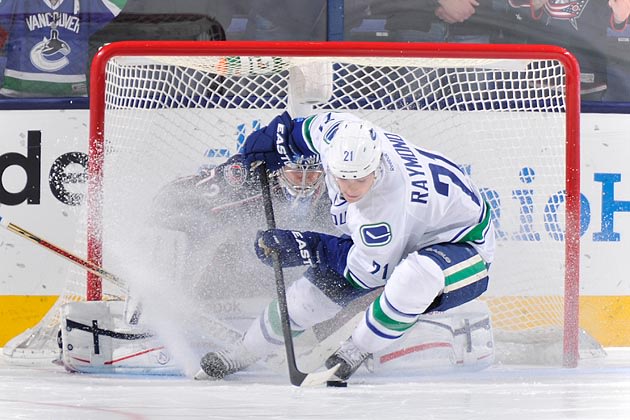
We’ve been debating its validity for years, and every month brings another moment of controversy, with Mason Raymond’s attempt against the Columbus Blue Jackets as the latest. Despite not exactly in keeping with the “puck moving forward at all times” thing, the NHL allows them as long as the move “involves continuous motion.”

Eliminate the spin-o-rama, and you eliminate a vast majority of the controversies we have in the shootout.
(But, again, the skills competition is such a ridiculous exercise in artifice that players should be able to shoot three pucks at the same time while firing a blow torch at the goalie’s face. You know, for entertainment’s sake.)

2. Hybrid Icing

For the uninitiated, this would transform icing into a race to the hash marks in the defensive zone; icing would be called as soon as the defensive player has the advantage – or is even – in the race to the end boards. No more shoves from behind or femur-shattering collisions at rink’s end.

It’s something that GMs like Steve Tambellini and especially Chuck Fletcher see as a common sense move, and it is: Hybrid icing helps prevent potentially catastrophic injuries while maintaining the visceral thrill of two players desperately chasing the puck. We’re still not sure how there’s opposition to that.

Speaking of icing …

3. Enough With Sneaky Delays of the Game

Every team knows how to earn its exhausted players some extra time to rest, whether it’s a goalie that needs an “equipment adjustment” or a player spending an extra second or 10 on the ice after an “injury.”

One trend in the NHL that’s been bugging me is on icing calls. It’s when teams empty their benches with players on a line change that legally can’t happen now that the defending team has iced the puck.

But rather than have five exhausted players immediately report to the faceoff dot near their goaltender to do the dance again, on-ice officials have to comb through a group of players to determine who needs to remain on the ice or back on the bench.

It’s a sneaky little move that I’ve seen employed by coaches like Peter Laviollette of the Philadelphia Flyers and Guy Boucher of the Tampa Bay Lightning, and has its roots in the mind of the late Roger Nielsen, that mad genius of rule-bending.

Defensive exhaustion leads to offensive chances. There’s no more established truth in hockey than that. So giving defensive players that extra time as this line change is sorted out is counter-intuitive to the icing rule that, frankly, is one of the better ones the NHL has passed.

Hit’em with a delay of game minor. Now we’re talking instant offense.

Of course, it doesn't stop there. As Jesse Spector noted on The Sporting News, teams are buying time in the faceoff dot as well by using wingers to take draws only to get tossed out of the circle:
“On every icing, the winger goes in (for the draw) and gets thrown out on purpose,” Islanders coach Jack Capuano said. “You see that everywhere you go. He’s getting thrown out so the center can take the draw and it buys five more seconds (after a team is not allowed to make a line change following an icing). That should be a rule that they should look at. That happens all the time. The officials, if they see something, a guy cheating once or twice, they’ve got to throw him out. I’ve got no problem with it.”
It's all a sneaky little delay.

Speaking of delay of game …

4. ‘Common Sense’ Puck Over The Glass

The moment I realized the “puck over the glass” delay of game penalty was idiotic was when I witnessed Matt Cooke of the Pittsburgh Penguins get a 2-minute minor after he shot the puck from his own end over the glass at the other end of the rink. Because, you know, that’s exactly where players are going to put the puck to delay the game. Yup.

Down Goes Brown picked apart this rule rather adeptly on Grantland, but came to the same conclusion I have:

The NHL wants more offense, but they can’t seem to figure out how to accomplish that at even strength. So why not add a nonsensical penalty that seems to have been specifically designed to create more power-play goals? Scoring goes up a little, everyone high-fives, and if we’re lucky nobody will mention that the rule is completely arbitrary and unfair.
In summary: It’s a rule that probably isn’t going to change, despite being awful, because it creates offense. And I’ve heard from enough coaches and GMs that are convince that it has actually decreased intentional pucks over the glass, whether or not that was an epidemic to begin with.

So if the rule isn’t going anywhere, let’s at least inject some common sense into the rule: Amend Rule 63.2 to give the referee some level of discretion on whether a player intentionally cleared the puck over the glass or simply misfired it.

We all see the games. We all know the difference. If you’re beef is that this turns referees into mind-readers … well, then we might as well take boarding majors away from them too.

5. Coach’s Challenge


As we’ve written this year: It’s beyond time for a limited coach’s challenge in the NHL. The technology is there to make reviews of plays efficient. The need is there for some check or balanced to be in place for game-changing calls like goalie interference on a scoring play or high-sticking double-minors in which one teammate cuts another.

As long as we limit them to one per game with consequences for teams that waste our time – a delay of the game minor, for example – they won’t become egregiously used.

What do you want to see the GMs recommend this week?

Tuesday, March 19, 2013

All aboard: NHL GM meetings will focus on boarding embellishment, icing alternatives


Getty Images 


When the NHL’s general managers meet this week in Toronto, they’ll engage in a discussion of what works and what needs fixing. Which is to say, a discussion of what you can fix and what might just be engrained, systemic problems in this gloriously violent sport of ours.
Some of it will focus on the boards surrounding the ice: Points of impact that can severely injure a player, in a broken bones or paralysis way, depending on the force being delivered by an opponent or the awkward way that player crashes into them.
Icing plays, for example, have always been at the forefront of “preventable” problems. That’s why modified icing was tested at the NHL’s Research and Development Camp in the last few years, and why hybrid icing was tested in the American Hockey League this season.
From the New York Times, we learn that icing will be on the agenda for Wednesday’s meeting:
The American Hockey League tried hybrid icing for 564 games during the lockout, calling it “positive.”
The dangers of high-speed chases to the end of the rink were recently highlighted by a horrific accident in the Swiss B League that left a 33-year-old defenseman, Ronny Keller, paralyzed. It was not an icing chase, but it resembled one, as Keller and a pursuing forward raced after a puck from red line to goal line and collided, sending Keller hurtling headfirst into the corner boards.
“I formed my opinion before that injury to the Swiss player — I’ve seen enough injuries related to the race for the puck,” [Carolina GM Jim] Rutherford said. “I like the hybrid icing, and I’d suppose we’ll be talking about it at the meeting.”
Is there enough traction for that rule to pass? Tough to say. These things seem to ebb and flow in popularity depending on when, and how gruesome, the latest injury was. All due respect to Keller, but he doesn’t play in the NHL, and that’s where the attention of the GMs and the Board of Governors is focused.
While icing injuries could be preventable, something else along the board may not be: Embellishment to gain boarding calls.

On Hockey Night In Canada, Glenn Healy offered the following take on embellishment:
Kevin Weekes dropping the European football comparison to NHL divers. Yowch.
Players turning their numbers to draw calls is, at this point, an epidemic.
Of course, it’s also the NHL’s own doing: When you fortify your rulebook and deputize your officials to target hits from behind, then players are going to do whatever it takes to draw penalties for hits from behind.
It’s the same reason why a total ban on contact with the head would never work – players would skate with their heads down more than Lindros did to draw calls. You’d see more shoe-gazing in the NHL than at a My Bloody Valentine concert.
The problem is that outside of referees determining, in a millisecond, the intent of the player being hit, there’s no eradicating embellishment along the boards, is there?
Do you dial back the rules on boarding? Sure, if you’re someone that’s keen on the NHL getting sued by crippled ex-players for putting them at greater risk by making the game less safe.
Do you adopt nonsense like the Brian Burke Bear Hug rule, in which player safety concerns usher in an era of legalized holding and obstruction in the offensive zone? Of course not. Because that’s always been a stupid solution to a practically unsolvable problem.
Embellishment is a tactic, whether it’s drawing a call in the slot or the neutral zone or along the boards. Yes, in a pristine world of sportsmanship and integrity, no one would dive or take advantage of the rules. Alas, the NHL is not, nor has ever been, that world.
So the GMs will talk about it, mull it over, demonize it to the media … and then do nothing about the embellishment each of their teams engage in.
Short of the NHL retroactively fining players for embellishment – like when you get a speeding ticket via a robotic camera on I-95 – it’s one of hockey’s engrained, systemic problems.

Monday, March 18, 2013

Tinordi sets up winner for Montreal in NHL debut


Series at a Glance

  1. Game 1: Canceled
    Montreal0
    @ New Jersey0
  2. Game 2: Final
    New Jersey3
    @ Montreal4
    Final
  3. Game 3: Final
    Montreal2
    @ New Jersey1
    Final
  4. Game 4: Tue, Apr 23 7:00 PM ET
    Montreal
    @ New Jersey


NEWARK, N.J. (AP) -- Things are going so well for the Montreal Canadiens that even the kids they are bringing up from the minor leagues are contributing.
Making his NHL debut, big defenseman Jarred Tinordi set up Tomas Plekanec's tiebreaking goal in the third period, and the Canadiens extended their winning streak to five games with a 2-1 victory over the New Jersey Devils on Saturday night.
''What a start for the kid,'' Canadiens coach Michel Therrien said of the 20-year-old son of former NHL defenseman Mark Tinordi. ''We're all pleased with the way he played the puck at net. It looked routine out there for him.
''He showed a lot of poise for his age and played very solid. He wasn't nervous. He saw more ice time because you can see him become more comfortable. He made the right decisions.''
The best decision by Jarred Tinordi was understanding that goalie Johan Hedberg's clearing pass from behind the net took a bad bounce off the sideboards and was heading to open ice above the left circle. The 6-foot-6 Tinordi skated toward the puck from the right side and let go a shot that Plekanec deflected past Hedberg at 6:49.
''I felt pretty comfortable out there,'' said Tinordi, who played 19 shifts and almost 15 minutes just two days after being called up from Hamilton. ''I think the nervousness and the butterflies were gone after the first couple of shifts.
''I tried not to think about the way I was playing. I knew we scored on the play. I didn't realize I got an assist. The boys were pretty happy for me. I was just shooting it to get it on net.''
Hedberg said the goal was the type one would expect to decide a tight-checking game.
'We make that play 20 times a game, and sometimes the puck doesn't want to go your way,'' said Hedberg, who finished with 20 saves. ''It came back to them and boom boom, it's in the net. It was one of those games that comes down to a goal like that, and we were weren't fortunate enough to get it.''
Colby Armstrong also scored for Montreal, and Carey Price made 32 saves. The Canadiens moved into a tie with Pittsburgh for the most points in the Eastern Conference.
Defenseman Peter Harrold scored for New Jersey, which lost for the second time in two nights (0-1-1).
''It's a tough one to swallow, but their goalie played well and so did ours,'' Devils forward Ilya Kovalchuk said.
Price was just a little bit better in making Plekanec's 12th goal of the season stand up. He stopped 18 shots in the third period, including a chest save through traffic on Patrik Elias with 1:24 left and stoning Adam Henrique and Travis Zajac in close in the final minute.
''They put a little bit of a full-court press on us, but our guys battled hard all night,'' Price said. ''We're working hard every night, trying to keep things simple. I think that's the style of play we have to have. We have good teamwork and that's what's working for us.
''I think our team is excellent in coming back after I make a save, collapsing on everything I leave out there, cleaning up the trash. We're sticking to the game plan and that makes it a lot easier.''
Playing for the third time in four nights, the Devils tied it 1-1 on Harrold's power-play goal at 3:54 of the second period.
With Ryan White off for holding the stick, Kovalchuk intercepted a clearing pass at the right point and slid the puck across the ice to Harrold. The defenseman got a shot off quickly and squeezed it between Price's pads for his first goal since Dec. 2, 2010 - a span of only 26 games for the journeyman, who has spent much of his career in the minor leagues.
Armstrong snapped a 39-game goal drought, dating to February 2012, to give the Canadiens the lead at 8:08 of the first period.
Devils defenseman Anton Volchenkov lost his footing shortly after a faceoff. Armstrong retrieved the puck, skated into the right circle and ripped a shot past Hedberg, who made his career-high 12 straight start in place of the injured Martin Brodeur.
Forward Mike Blunden, who grabbed an early-morning flight after being recalled from Hamilton, appeared to screen Hedberg on the play.
''You have to like the way the young guys played,'' Canadiens captain Brian Gionta said. ''They came through.''
Goal posts kept both teams from taking the lead during the same second-period penalty. Kovalchuk, who leads the NHL with four short-handed goals, just missed another on a 2-on-1 break while Harrold was in the penalty box.
Lars Eller beat Hedberg about a minute later, but that puck also struck a post.
NOTES: The Canadiens have scored first in 21 of 28 games. ... Montreal RW Michael Ryder had his streak of 114 consecutive games played snapped because of a lower body injury. He last missed a game in March 2011. ... Devils C Andrei Loktionov, who was hurt Friday against Philadelphia, sat out due to an undisclosed injury. ... C Harri Pesonen made his NHL debut for New Jersey. .. Harrold was cut badly on the forehead by a shot in the third period, but returned to the game. ... The Devils honored former goalie coach Jacques Caron before the game.


Thursday, March 14, 2013

NHL governors approve realignment


NEW YORK (AP) -- NHL owners have made it official: The Detroit Red Wings and Columbus Blue Jackets are heading east.
The league announced Thursday that its board of governors approved a realignment plan that will go into effect next season. The new format will feature two eight-team divisions in the Eastern Conference, and two seven-team divisions in the West.
That means Detroit and Columbus will switch conferences by moving into the East, while the Winnipeg Jets will move into the Western Conference.
Realignment will also create changes in determining the 16-team playoff field. The top three teams in each division will qualify for the postseason. The next two teams with the best records in each conference will then earn wild-card berths.
That will make it more difficult for teams to qualify in the East, because it will have two more clubs than the West competing for eight berths.
The NHL Players' Association had already signed off on the realignment format, which will be in place for at least three seasons.
''The new alignment will place several clubs in more geographically appropriate groupings, and will intensify already-fierce rivalries throughout the league,'' the NHL said.
The changes will also make it easier on team's travel schedules, with Detroit and Columbus no longer having to make numerous and extended trips outside the Eastern time zone. The Jets will also gain some normalcy in travel after spending the past two seasons as members of the Southeast Division.
The Atlanta Thrashers' relocation to Winnipeg two years ago helped precipitate the need for realignment.
Detroit will be placed in a division with Boston, Buffalo, Florida, Montreal, Ottawa, Tampa Bay and Toronto.
Columbus will now contend with Carolina, New Jersey, the Islanders, Rangers, Philadelphia and Pittsburgh.
Winnipeg will join a division featuring Chicago, Colorado Dallas, Minnesota, Nashville and St. Louis.
The switch also allows both Minnesota and Colorado to move from the Northwest Division and into a more centrally based division.
All teams will play each other both home and away at least once each season. And teams will play division rivals at least four times a season.

NHL Awards Watch: What if Ryan Suter gets Norris nod and Shea Weber doesn’t?


Getty Images(Ed. Note: This is a weekly feature on Puck Daddy in which we vote on the major NHL Awards. “We” being Wyshynski, Leahy, Mooney, Yahoo! NHL editor Sam McCaig and Yahoo! NHL scribe Nick Cotsonika. Voting is completed Monday night. The results will run every Tuesday on this very blog. Enjoy.)


When Ryan Suter left the Nashville Predators for the Minnesota Wild, there was one question on everyone’s mind: Would he have to play 30 minutes a night this season to justify that salary?
The second question: How would both Suter and Shea Weber cope with their very successful partnership ending?
We’re starting to get a sense of that, at least for this season. Suter is sixth in the NHL in defensive scoring, with 18 points in 24 games, playing 27:29 a night. Weber has 13 points in 25 games, skating 25:45 per night. And yet in the latest Puck Daddy NHL Awards Watch, it’s Suter that’s cracked the top five for the Norris Trophy while Weber received a single fifth-place vote.
What if Ryan Suter gets a Norris nomination while Shea Weber doesn’t?
The way Minnesota is playing, that’s entirely possible this season. His profile is growing right along with their win total. But talk about your upsets: Would anyone have predicted that before the season?
Coming up, the Norris race and the other trophies in our weekly awards watch.
A note on the voting: All four panelists ranked the top five for each award, and point values were assigned to each player. Ties were broken by how high a player was ranked on the majority of ballots.
Hart Trophy
1. Sidney Crosby, Pittsburgh Penguins (25)
2. Patrick Kane, Chicago Blackhawks (18)
3. Steven Stamkos, Tampa Bay Lightning (12)
4. Ryan Getzlaf, Anaheim Ducks (6)
5. Eric Staal, Carolina Hurricanes (3)
Crosby was the unanimous choice for the MVP award, with Patrick Kane representing the NHL’s best team in the first half of the season. Stamkos remains the third choice, ahead of a surging Ryan Getzlaf and his spiffy new contract. Eric Staal is on arguably the best line in the East. Antti Niemi and Craig Anderson were goalies among the honorable mentions, along with center John Tavares of the New York Islanders.
Norris Trophy
1. Kris Letang, Pittsburgh Penguins (22)
2. Oliver Ekman-Larsson, Phoenix Coyotes (14)
3. Kevin Shattenkirk, St. Louis Blues (12)
4. Francois Beauchemin, Anaheim Ducks (9)
5. Ryan Suter, Minnesota Wild (6)
Interesting field shaping up for the best defenseman prize. Letang is the NHL point leader for D-men with 26. Shattenkirk is third with 19. (What, no love for Kimmo Timonen, second with 19 points?) Ekman-Larsson has been all-around solid this season, while Beauchamin carries the torch for all defensive defensemen.

Vezina Trophy
1. Craig Anderson, Ottawa Senators (20)
2. Antti Niemi, San Jose Sharks (14)
3. Corey Crawford, Chicago Blackhawks (14)
4. Tuukka Rask, Boston Bruins (9)
5. Carey Price, Montreal Canadiens (7)
Despite not having played since Feb. 21, Anderson’s stellar work for the Sens hasn’t been forgotten by the panel. Niemi moves up to the No. 2 slot with 10 wins in 20 starts and a 1.96 GAA. Crawford (1.91 GAA) is right with him. Rask jumps onto the countdown with 13 wins in 18 starts, while Price remains among the league’s workhorses and biggest winners (13). Pekka Rinne and Viktor Fasth lurk just outside the top 5.
Calder Trophy
1. Jonathan Huberdeau, Florida Panthers (23)
2. Cory Conacher, Tampa Bay Lightning (19)
3. Brendan Gallagher, Montreal Canadiens (16)
4. Justin Schultz, Edmonton Oilers (10)
5. Alex Galchenyuk, Montreal Canadiens (2)
The Panthers rookie leads’em all with 12 goals on the season, the only rook in double digits. Conacher leads the rookie scoring race as the first to 20 points. Gallagher has 15 points and continues to play pivotal minutes for the Habs. Schultz leads rookie defensemen with 15 points, but is saddled with a minus-10. Galchenyuk narrowly edged Jake Muzzin, Dougie Hamilton and Vladimir Taresenko.
Jack Adams
1. Joel Quennville, Chicago Blackhawks (24)
2. Bruce Boudreau, Anaheim Ducks (17)
3. Paul MacLean, Ottawa Senators (15)
4. Michel Therrien, Montreal Canadiens (13)
5. Kirk Muller, Carolina Hurricanes (3)
The top four have been solidified for some time in the Adams race, with Coach Q still just ahead of Boudreau. Muller edges out Claude Julien and Randy Carlyle for the final slot.

Wednesday, February 20, 2013

From prospect to player, Nazem Kadri is making the most of his time in Toronto

Nicholas Cotsonika


The key moment for Nazem Kadri came not with the Toronto Maple Leafs, but with the Toronto Marlies, their minor-league affiliate. It came in a meeting with Dallas Eakins, the kind of meeting coaches often have with skilled players about the other side of the game. 


The Leafs have given Nazem Kadri a chance, and he's responded by leading the team in scoring. (USA Today)Simply telling Kadri what to do wasn't working, so Eakins started asking questions: "If you were your opponent in this situation, what would you want Nazem Kadri to do? What would you not want Nazem Kadri to do?" Kadri discovered that he knew the answers – where to go when you don't have the puck, how to manage the puck when you have it, and why.
"I would say to Naz, 'You should be the best defensive player on our team, because you know every offensive trick there is,' " Eakins said. "Then suddenly it started to click. We just had to teach him a different way."
So when was this epiphany? When Kadri played for the Marlies during the lockout? Is that why the seventh overall pick in the 2009 draft looks like he's now in the NHL to stay at 22 years old, leading the Leafs in scoring and playing a more complete game a quarter of the way through the season? Not exactly.
"It was a couple years ago," Eakins said.
This is a story about development. Every player is different, every situation is different and the path to the NHL is not necessarily a straight line even for a top-10 pick. Players have to learn how to fit in. Coaches have to learn how to fit them in. It has been a particularly delicate dance in Toronto for Kadri.
The Leafs love having their AHL affiliate in the same city. It's great for logistics. It's great for marketing. It's great for motivating players. As the Marlies' slogan goes: "Every game is a tryout." Problem is, when a player goes from the Leafs to the Marlies, he goes from Toronto to Toronto. He cannot lick his wounds in obscurity in, say, Binghamton. He suffers his embarrassment in the same fishbowl from whence he came. Every demotion is dissected.
"Boy, it's wonderful when you get called up," Eakins said. "But when you get sent down, it's not like you're out of there."
Now consider Kadri. He was born in London, Ontario. He starred for the London Knights of the Ontario Hockey League. He became the top prospect for a team lacking top-end talent that hadn't made the playoffs since 2004 and hadn't won the Stanley Cup since 1967 in the Center of the Hockey Universe – a perfect storm of pressure. When he had three goals and five points in six preseason games in 2009, just before he turned 19 and returned to junior, it only raised expectations.


But Kadri struggled in the preseason in 2010 and went to the Marlies, and he spent two seasons shuttling up and down. Ron Wilson, the Leafs' coach most of that time, didn't mince words about Kadri's deficiencies in public or in private. Randy Carlyle, who replaced Wilson late last season, said he knew all about the Kadri drama – while he was coaching the Ducks out in Anaheim. If you paid attention to hockey, you couldn't help but hear about it.


Leafs coach Randy Carlyle has shown confidence in Kadri, and that faith has been rewarded. (USA Today)Kadri couldn't help but think about the Leafs whenever he was with the Marlies – at home, out to eat, about town. He'd watch Leafs games or see Leafs jerseys on the street, and he'd feel both motivation and disappointment. He felt Wilson didn't put him in position to succeed. Wilson divided his forwards into top-six and bottom-six roles. He stuck Kadri in a bottom-six role on the wing when Kadri was supposed to develop into a top-six centerman.
"Some of the staff my first two years, I guess we butted heads a little bit," said Kadri, not naming names. "They didn't have the same confidence that Randy has in me. ... If you ask me if I thought I could do this my first year, the answer would probably be yes because I believe in myself."
But why does Carlyle have more confidence in Kadri than Wilson did? And was Kadri really ready to play in the top-six his first year or even his second? It might be easier to give Kadri some honey now because he was fed vinegar before. Kadri had to be humbled, and he had to break bad habits and develop good habits to be put in this position. He was the classic case of a talented prospect that didn't need to worry about the details while in junior, but had to mature as an athlete, as a person, and as a player.
"He never had to be fit," Eakins said. "He never had to be strong. He had so much skill it didn't matter. He did what he wanted on the ice. He was so relied on offensively that I think sometimes they looked the other way on his defensive liabilities."
Kadri improved his eating and training, going from about 167 pounds to about 185. Eakins taught him to play the complete game by coming back to skill. To show your skill, you have to possess the puck, right? So play defense to get the puck back and limit turnovers to keep it on your stick. But Eakins also taught Kadri when not to use his skill – to chip in the puck at the right time, to eat pucks down low at the right time, to be aware of the score and the clock and not get cute at the wrong time.
The lockout was a benefit. Kadri had more time to develop in the AHL, and he could do it without the pressure and distraction of the NHL. No one could ask why he was in the minors. He couldn't long for what he was missing. The Leafs weren't playing.
Carlyle said his assessment was that Kadri was more effective at center than the wing because "he wasn't as vulnerable to some of the things I thought wouldn't allow him to play." He said the Leafs "couldn't put him in a checking role and expect him to flourish in that capacity." Kadri is still the third-line center, but under Carlyle, that's usually a "top-nine role" with skilled players, not a "bottom-six" role with grinders. Kadri is also getting power-play time.
"I get the feeling that he likes me and he likes me as a player," Kadri said. "That helps me out a lot when I know my coach actually can believe in me and have faith in me. That makes me want to work that much harder for him.
"Did I feel that way before? Absolutely not. Not even close. I felt left out. I felt like ... Even though I never, ever once stopped believing in myself, I didn't think other people believed in me. It's a whole different thing putting me with guys that actually can play on the same page as I can offensively. He gives me an opportunity to make myself known and to succeed, whereas before it didn't really seem that way."
Kadri said he has "matured" as a player and that he has "fixed everything they've wanted me to."
He is still maturing, still fixing, of course. Though he leads the Leafs in scoring – pretty good for a third-liner who lost a red-hot wingman in Matt Frattin to injury – Phil Kessel started slowly and Joffrey Lupul got hurt. Kadri has 12 points in 15 games. He needs to keep producing while working on his faceoffs and the other details he has been working on for the last three years. He cannot afford to slip back into bad habits.
But he reached this point by learning to look at the game differently in the minors, and now he looks at the minors differently, too.
"Dallas Eakins and me really beared down, and he stuck with me the whole way, and that's what you get – results," Kadri said. "It may have taken a couple years – a long couple years – but it's worth it in the end."


Friday, February 15, 2013

Buddy, can you spare a quarter?

By Scott Burnside | ESPN.com


In a flash, a quarter of the NHL season is behind us. Things won't slow down as we race pell-mell to the end of the season, on April 27.

And so, without further ado, some first-quarter superlatives and, well, whatever the opposite of a superlative might be:

Dominating Performance By A Non-Star Player

David Clarkson, New Jersey Devils


Clarkson might have played in the shadows of Zach Parise, Ilya Kovalchuk and Martin Brodeur as the Devils went to the Stanley Cup finals in June, but he's proved he's no flash in the pan through the first quarter.

He has nine goals, tied for second in the NHL as of Monday night, to pace the surprising Devils, who roared to the top of the Eastern Conference standings with an 8-1-3 record.

Honorable mentions: Tobias Enstrom, Winnipeg Jets; Craig Anderson, Ottawa Senators

Dominating Performance By A Star Who Was In Danger Of Losing His Star Status 

Patrick Kane, Chicago Blackhawks


The Chicago Blackhawks are by any measure the best team in the NHL at the quarter mark, and one of the main reasons is the return to form of former rookie of the year, former (?) party boy, Patrick Kane.

Whatever he's doing or not doing off the ice, on the ice he's on fire with 19 points and nine goals, both good for second in the league. If the Blackhawks are looking a lot like the team that won a Stanley Cup in 2010, it's because Kane is at the peak of his powers.

Honorable mentions: Patrick Marleau, San Jose Sharks; Thomas Vanek, Buffalo Sabres

Disappointing Performance By A Bona Fide Star Player

Drew Doughty, Los Angeles Kings


Lots of potential candidates in this category with the offensively challenged Kings, who began the week tied for last in the Western Conference, but Doughty's start is reflective of the entire team's inability to get out of the gate. After shouldering his way into Conn Smythe Trophy discussion during the Kings' run to the Cup in June (netminder Jonathan Quick ultimately earned MVP honors) Doughty appears to be slumbering, with zero goals, four assists and a whopper minus-10, dead last in the NHL. Now we know plus/minus isn't necessarily a reflection of a players' level of play, and we know Doughty shook off a slow start last season to be a dominant player, but for a guy many predicted would be a Norris Trophy candidate, it hasn't been a pretty start.

Honorable mentions: Shea Weber, Nashville Predators; Nicklas Backstrom, Washington Capitals

Biggest Injury Loss

Jason Spezza, Ottawa Senators


Unfortunately, there are lots of candidates in this category, but the Senators are going to have scrape and scrounge for offense with their top pivot out for what looks like most if not all of the regular season with a back injury. Kudos to head coach Paul MacLean for keeping his squad in the Eastern Conference playoff mix in the early going after Spezza went out of the lineup after just five games -- but is it sustainable without Spezza?

Honorable mentions: Scott Hartnell, Philadelphia; Steve Downie, Colorado Avalanche

Out-Of-Nowhere Goaltending Performance

Devan Dubnyk, Edmonton Oilers


If there was one question mark about the talented, young Oilers it was whether someone would put his mark on the No. 1 goaltending job. It's early, but credit goes to Dubnyk, who has stood tall when the Oil have struggled to score, rolling to a 5-3-3 record, including a 39-save performance against Columbus in a 3-1 win Sunday night.

Honorable mentions: Viktor Fasth, Anaheim Ducks; James Reimer, Toronto Maple Leafs

Nowhere Goaltending Performance

Braden Holtby, Washington Capitals


It's been a forgettable quarter for many No. 1 netminders this winter but the disappointing play of last year's playoff sensation, Braden Holtby, he of the 3.87 GAA and .879 save percentage, has been one of the key factors in the slow (OK, "slow" doesn't really cover it) start for a Washington team that was ranked dead last in the NHL as of Monday.

Honorable mentions: Brian Elliott, St. Louis Blues; Ryan Miller, Buffalo Sabres

Tight Around The Collar Coaching Performance

Mike Yeo, Minnesota Wild


In spite of the addition of the $200 million men Zach Parise and Ryan Suter ($196 million, technically), it's more of the same for the Minnesota Wild as they find themselves outside the Western Conference playoff bubble with a .500 record and a popgun offense that ranked 27th in goals per game and the 19th-ranked power play as of Monday night. After last season's collapse that saw the Wild go from the top of the NHL standings to the nether regions, the team's play thus far is just a little too familiar for the restless fans in the State of Hockey.

Honorable mentions: Lindy Ruff, Buffalo Sabres; Joe Sacco, Colorado Avalanche

Surprisingly Loose Around The Collar Coaching Performance

Joel Quenneville, Chicago Blackhawks


Lots of discussion about Joel Quenneville's future with the Blackhawks after two straight one-and-done playoff performances. Well, how about a Jack Adams Award in Quenneville's future as coach of the year? The Blackhawks' superlative start, one that includes an 8-0-2 record on the road, should put to rest any questions about Quenneville's standing in Chi-Town.

Honorable mentions: Bruce Boudreau, Anaheim Ducks; Todd McLellan, San Jose Sharks
Big Signing Payoff

P.A. Parenteau, Colorado Avalanche


Still not sure why the New York Islanders let the emerging winger escape their clutches -- oh, yeah, it was because Parenteau wanted to be paid in real dollars, not Charles Wang Meal Vouchers -- but the Avs have to be happy with Parenteau's seven goals after inking him to a four-year deal in the offseason. Now, if the Avs would just get Ryan O'Reilly signed, they might actually have a shot at the playoffs.

Honorable mentions: Damien Brunner, Detroit Red Wings; Zach Parise, Minnesota Wild

Big Signing Question Mark

Ryan Suter, Minnesota Wild


A personnel director recently spoke about the special chemistry/relationship that Ryan Suter had with long-time defense partner Shea Weber in Nashville. Now Suter is "the man" in Minnesota and it's not really his style (Weber, by the way is missing Suter just a bit, coming up with just one assist in the Preds' first 12 games). It's not that Suter has been terrible but zero goals, six assists and a minus-7 is just middle of the road -- and for a guy who signed a contract worth just shy of $100 million last summer, middle of the road isn't going to cut it.

Honorable mentions: Filip Kuba, Florida Panthers; Olli Jokinen, Winnipeg Jets

Best Performance By A Graybeard

Teemu Selanne, Anaheim Ducks


The 42-year-old marvel recorded his second four-point night in 22 days on Saturday night against St. Louis. Only Gordie Howe and Tim Horton have had four-point efforts after the age of 42, Elias Sports Bureau reports (courtesy of the Ducks' crack PR staff). And, oh yeah, Selanne is leading the Ducks with 14 points. Last time he had this many points through 11 games? The 1995-96 season, when he was 25.

Honorable mentions: Saku Koivu, Anaheim Ducks; Martin Brodeur, New Jersey Devils

Lunchbag Letdown (Team Category)

Washington Capitals


We still figure the Caps to get back in the playoff hunt in the Eastern Conference but, wow, talk about a big hole. Problems: Alex Ovechkin adjusting to a new position on the right wing, some of the team's best players not ready to play post-lockout, mediocre goaltending and rookie head coach Adam Oates trying to make sense of it all.

Honorable mentions: Philadelphia Flyers, Los Angeles Kings

Worst Attempt To Buy A Hockey Team

Greg Jamison


Greg Jamison led people around the hockey world to believe he had the goods to buy the Phoenix Coyotes and end the misery of the Yotes' ownership saga. Uhm. Not even close. The Coyotes might yet get sold and they might yet end up staying in the desert but don't count on Jamison on being part of that if it happens. By the way, fans at Jobing.com Arena have quickly gone from rabid supporters during the Coyotes' playoff run last spring to nonexistent as the ownership debacle heads toward its four-year anniversary.
Honorable mention: Not applicable.

Player Whose Name Is Often Mentioned As Trade Bait

Henrik Lundqvist -- OK, just kidding; Roberto Luongo, Vancouver Canucks


The ongoing goaltending saga in Vancouver might be interesting to the water-cooler set but the bottom line is that the Canucks hit the quarter mark on fire and with the best one-two punch in goal of any team. Both Cory Schneider, anointed the Canucks' goalie of the future after last season, and Luongo, who will at some point be traded out of Vancouver, and GM Mike Gillis have all played this above-board and the two netminders actually seem to like each other. Credit to Gillis for apologizing to Washington GM George McPhee for showing up in Washington and setting off a three-alarm rumor blaze that Luongo was about to become a Cap. So, what comes first: a Luongo trade or a Cup parade through Vancouver's beautiful downtown?

Honorable mentions: Corey Perry/Ryan Getzlaf, Anaheim Ducks; Phil Kessel, Toronto Maple Leafs