Showing posts with label photos. Show all posts

Sunday, March 31, 2013

Antonio “Bigfoot” Silva Promises Second Fight with Cain Velasquez Will Be Much Different

MMA Weekly5 hours ago
When Antonio “Bigfoot” Silva steps into the cage against UFC heavyweight champion Cain Velasquez at UFC 160 on May 25 in Las Vegas, he will be re-matching a man who – at almost a year to the day – gave Silva the worst beating of his eight-year career. Only this time, he knows exactly what he won’t be doing come fight time.
“First thing, no kicks. That is very important,” Silva said recently during a press tour in anticipation of the Memorial Day Weekend meeting with Velasquez.
It’s understandable that Bigfoot doesn’t want to throw kicks against the hulking Mexican-American. In their inaugural meeting, it took about 30 seconds for Velasquez to grab a kick from the Brazilian, rip him to the mat, and beat him senseless by 3:36 of the opening frame.
That loss, on May 26, 2012, was the second consecutive loss for Silva. He was previously knocked out by Velasquez’s teammate and perennial contender Daniel Cormier at the Strikeforce Heavyweight Grand Prix Semifinals in September of 2011. Since those crushing defeats, the six-foot-four, 265-pound Brazilian behemoth has back-to-back knockout victories over the previously undefeated Travis Browne and a vicious “Knockout of the Night” third-round comeback over top-ranked Dutch striker Alistair Overeem at UFC 156 in February.
Despite being 2-2 in his last four fights, Silva is quick to dismiss any criticism of him earning this title shot against Velasquez. For Bigfoot, it’s just simple math.
“I fight two of the best guys in the weight division in the UFC,” he stated. “Travis Browne never lost. He’s a tough guy. And the other guys, Alistair Overeem was number two or three in the world, and if he would have beaten me he was going to fight for the belt.”
By defeating the widely viewed number one contender in Overeem, Silva dispatched of the hype-train that was “Ubereem” and earned the respect of MMA fans across the globe. Silva says that he never had been so enraged at a fighter’s pre-fight trash talk, a feeling that was more than evident when Silva stood over a lifeless Overeem, taunting the former K-1 Grand Prix Champion at the conclusion of their scrap.
“I said, get up! Get up! You don’t want to fight, (expletive)!”
A truly terrifying visual to any of those who had the pleasure (or pain) of watching that fight unfold.
Now with a re-match looming against Velasquez, Silva faces questions about whether or not he will be mustering the same anger that helped fuel his comeback win against Overeem.
“Yes (I’ll be angry),” he said. “The first reason why, is, I want the title.
“And the second thing, every day I get up and look in the mirror (and see) the big cut on my face, for this, I’m very angry.”
After giving Silva 15 stitches in the center of his face, Velasquez went on to reclaim the heavyweight title from Silva’s countryman and sometime training partner, Junior dos Santos, at UFC 155.
“Cigano,” who also was in attendance on Wednesday, had some very poignant advice for his comrade; advice that will surely be elaborated on more as the fight draws near.
“I think he has to put some pressure on him,” said the former heavyweight champion. “You can’t stay waiting too much for Cain Velasquez.
“You have to go there and beat him like this: you have to go in there and put pressure on him. That’s my opinion. We already talked a little bit about this and I truly believe that he will win.”
As the two Brazilians share a massive meal of steak and shrimp, they go back and forth about a myriad of subjects and shared memories. Silva listens intently to dos Santos, but he wants to make one thing clear, although this is a new fight, he won’t be changing his strategy when he meets Velasquez for a second time.
“I’m going to train the same strategy as I trained before,” said Bigfoot. “The problem was my mind, my adrenaline. But I’m going do the same thing. I have a lot of skills to win this fight.”
Like many championship-level fighters, Silva realizes that your losses are just as important as your wins if you’re going to grow as a martial artist.
“The first fight with Cain is very important because I learned a lot from it,” said Silva. “[That] fight, I was very nervous because it was my first fight in the UFC. Now I’m very, very different. I have a good camp. I’m going to do the same strategy, and this fight will be very different.”

Pat Riley's shut-the-bleep-up message to Danny Ainge a show of support for LeBron James

Pat Riley called Celtics general manager Danny Ainge a "whiner." (AP)

Miami Heat emperor Pat Riley isn't responsible for creating the NBA's culture of hard fouls and cheap shots, but no one in its history has profited so handsomely in the pursuit of perfecting it.
In honoring two historically indisputable professional habits – establishing himself as the patriarch and protector of his star player; and wrapping himself in downright disdain for the Boston Celtics – Riley sent a missive to one of his messengers on Good Friday.
"Danny Ainge needs to shut the [expletive] up and manage his own team," Riley proclaimed. "He was the biggest whiner going when he was playing and I know that because I coached against him."
This was a spectacularly jarring response to Ainge, who had chastised LeBron James and his declaration that the NBA and its officials don't do enough to protect him. "I think that it's almost embarrassing that LeBron James would complain about officiating," Ainge had told WEEI radio in Boston.
For Ainge, he has been his vintage self: agitating, inciting, inspiring an irrational over-the-top response. If Riley's response feels unprecedented, remember something: The re-recruitment of James to re-sign in 2014 is underway, and this was Riley's way to back his franchise star. Even so, Riley's never needed a noble reason to grandstand. When it serves his agenda, no one steps down off Olympus and delivers the arrows like him.

In a season when James had manufactured no storylines beyond the perpetual testimonials about the greatness of his game, his venting in Chicago on Wednesday night promises to be the beginning of the framing of how he'll be officiated in these playoffs.
This is a copycat league, and this episode will turn out to be one more way in which Bulls coach Tom Thibodeau has become the most mimicked of all.


Ainge criticized LeBron James for complaining about opponents' hard fouls. (AP)


When Golden State Warriors coach Mark Jackson wanted to install a defense, he made young assistant Darren Erman – a Thibodeau disciple in Boston – his defensive coordinator. The improvement's been dramatic. And when teams want to defend James, they'll study Thibodeau's blueprint.
Of course, everyone doesn't have the Bulls' personnel to be physical with James, nor the ferocious defensive mindset within their players. Still, Thibodeau is stubborn and he'll never let his players back down to James and the Heat. So stubborn, in fact, Thibodeau still hasn't signed the four-year, $17.5 million-plus contract extension that Bulls commemorated with an Oct. 1 news conference.
"The deal's done," Thibodeau told Yahoo! Sports on Wednesday night. Nevertheless, he wouldn't acknowledge that it had been signed because that still hasn't happened, several sources with direct knowledge of the contract told Y! Sports.
This is how Thibodeau operates, part of his maddening genius. He wears everyone down until he gets everything he wants – front offices, players, and often opponents too.

Back in his assistant coaching days in Boston, his contracts lingered unsigned, too. Looking back, no one is sure that Thibodeau ever signed the waiver confirming that he'd never sell his personal engraved 2008 championship ring when those were handed out to staff.
In the end, remember something: Thibodeau is a disciple of Jeff Van Gundy, who is a disciple of Riley. Deep down, Riley understands something: the way with which those Bulls engaged James to end that 27-game winning streak had been the ultimate tribute to Riley himself. Thibodeau sent those Bulls hard for James, and it stirred something within the NBA's MVP that no one had heard out of him this season.


James wasn't happy with the officiating in the Heat's loss to the Bulls. (AP)

James is a product of a different day in the NBA, a different generation and the evolution of the sport spared him the beatings delivered in the 1980s and '90s. Nevertheless, how James is officiated is an issue for the NBA this season and beyond. That's been true forever with the league's best players, and always will be.
More and more, the league office has made life easier for offensive stars – legislating easier paths to scoring, punishing hard fouls with free throws, fines and suspensions. Once, David Stern changed the rules to make it harder for the Chuck Dalys and Rileys to beat up on Michael Jordan.
Now, it will be Adam Silver's turn with James. Make no mistake: James and his inner circle have a strong relationship with Silver, who'll replace Stern as the NBA's commissioner in 2014. Silver is so fond of James' business manager Maverick Carter, he granted an interview with Forbes to render some fluffy quotes for a profile on Carter.
Stu Jackson has long overseen basketball operations for the NBA, but he's begun the pursuit of returning to the front office of a team, sources told Yahoo! Sports. The restructuring of the league office could ultimately be dramatic, and those within the NBA are watching closely to understand how it'll eventually trickle down to the product on the floor.

In the end, Riles' statement was one for the history books, one of the best two-sentence releases pro sports has ever seen. Riley needs enemies, and the Celtics and Ainge will forever play the part for him. At the highest levels, the Celtics and Heat share a visceral hatred and that's increasingly rare in this buddy-buddy era.
After a Game 2 loss to Miami in the Eastern Conference finals in May, Ainge cornered the NBA's vice president of referee operations, Joe Borgia, in an American Airlines Arena corridor and tried to understand how James could go to the free throw line 24 times, the Heat 47.
Just trying to break free, Borgia finally blurted to Ainge, "I'm sure we missed five or six calls somewhere."
Boston believes Dwyane Wade went out of his way to hurt Rajon Rondo with a tackle that dislocated his elbow in the 2011 Eastern Conference playoffs. And, of course, there was the Heat's successful free-agent recruitment of Ray Allen last summer.
So, yes, James spoke out about all those non-basketball plays that have endangered him this season, borne out of a night when Thibodeau had his players honoring the lessons that Riley had taught Thibs' own mentor, Van Gundy, so long ago.

And upon stepping out of the shadows on Good Friday, as much as Pat Riley was taking shots at the Celtics GM and defending his own superstar player, he had done something else too: Riley took a bow.
They're all coming for James, coming harder and harder. Remember that it was the emperor of these Miami Heat who taught them all how to do it, who glamorized the hard foul and the cheap shot and the culture that comes for LeBron James now.

Saturday, March 30, 2013

Three Periods: Flames fumbled Jarome Iginla for years; Sharks test trade waters; 'Canes comfy with Alex Semin gamble

FIRST PERIOD: Flames fiddled around with Jarome Iginla for far too long


Former Flames captain Jarome Iginla at his farewell press conference in Calgary. (Reuters)


The Calgary Flames should be embarrassed. Deeply, deeply embarrassed. Because this goes beyond the obvious – that they waited far too long to trade captain and icon Jarome Iginla, that they let one team believe a deal was done only to have him waive his no-trade clause for another team, that they got far too little in return. Let’s not lose sight of why they had to trade Iginla in the first place.

This has been a misguided and mismanaged franchise for years, and it certainly didn’t start with current general manager Jay Feaster, who presided over this shortly after the Ryan O’Reilly offer sheet fiasco. The blame reaches back to former GM Darryl Sutter – which has to just burn Flames fans, who watched him come out of his Alberta exile last season and win the Stanley Cup as coach of the Los Angeles Kings. It extends to team president Ken King and up to chairman Murray Edwards.

Bad drafts. Bad trades. Bad signings. Bad decisions in so many areas for so many years. The Flames didn’t just waste Jarome Iginla as an asset. They wasted Jarome Iginla as a player. A good organization would have recognized reality – that this was not a playoff team, let alone a potential Cup contender – and would have moved Iginla long ago in a smart way to start the rebuild. A better organization wouldn’t have had to move Iginla at all because it would have actually built a playoff team around him.


Iginla had a no-trade clause and was close to Edwards. He loved Calgary and was beloved by Calgary. Maybe he was just as delusional and stubborn as management, and maybe all that made him more difficult to trade. At a news conference Thursday, he wouldn’t rule out coming back to the Flames, saying: “I think the organization is going in the right direction.” He slipped and still called the Flames “we.”

But it was not Iginla’s job to make tough decisions, and it was not his job to surround himself with talent. It was his job to lead and perform, and his loyalty and class helped make him more than just a star player. He did his part even as he aged and his teammates struggled, all his numbers going for naught.

Iginla scored 32 goals at age 32 in 2009-10, when the Flames didn’t make the playoffs. He scored 43 goals at age 33 in 2010-11, when the Flames didn’t make the playoffs. He scored 32 goals at age 34 last season, when the Flames didn’t make the playoffs. And he has nine goals in 31 games at age 35 this season – a 22-goal pace over an 82-game schedule – with the Flames out of playoff position yet again.

Had the Flames decided to trade Iginla a year or two ago, they could have done this the right way. They could have worked with Iginla to create a market that would reap a decent return, and theoretically the assets they acquired would be paying dividends by now. It would have been brutal, but it could have been dignified and productive. Most fans and media would have understood. Many were calling for it.


By waiting, they ended up stuck – under pressure to do something with Iginla on an expiring contract, with Iginla in control because of his no-trade clause. The Boston Bruins offered the best deal, even if it wasn’t great, and the Flames agreed to it. But Iginla picked the Pittsburgh Penguins, who offered even less than the Bruins did, and so the Flames had to accept only a late first-rounder and what experts consider two C-list college prospects. They are not going to start a rebuild with that.

But worst of all, by managing the team so poorly after their run to the Cup final in 2004, they squandered the back end of Iginla’s prime and made their captain the subject of trade rumors for years, testing his character in all sorts of uncomfortable situations.

Could they have refused to trade Iginla to Pittsburgh and tried to force him to Boston to get the best return? Could they have refused to trade him at all? Maybe. But they’re the ones who gave him the no-trade clause, they’re the ones who put him in this position, and they’re the ones who would have looked classless, not just clueless, had they tried to play hardball. And what if they alienated him so much that he left for nothing as a free agent?

Failure begets failure. Even though the Flames have finally recognized the need to rebuild and finally traded Jarome Iginla, there is no reason to believe they are about to break the cycle. Their future looks as bleak as ever.

They’re lucky Iginla wanted to stay for so long. It’s incredible he won’t rule out coming back. You’d think it would have been Iginla asking for a trade, not the other way around.

SECOND PERIOD: Sharks test the water ahead of NHL trade deadline


The Sharks have some big decisions on the eve of the NHL trade deadline. (Getty)


Listen to what San Jose Sharks GM Doug Wilson said Monday after trading defenseman Douglas Murray to the Penguins: “Can it lead to other deals? Sure, it can. There are certainly a lot of teams that are in contact with us.”

Wilson said it was “not acceptable” how the Sharks had played after their 7-0-0 start, and he made it clear that their performance before the trade deadline would have a great impact on what he decided to do.

“They’re all big boys,” Wilson said. “They know what’s on the line here. To me, actions speak louder than words. Play well. Let us know where you’re at with your game. … I’d like to see us over the next little while in particular step up our game. There’s no reason why we can’t.”

Well, look what has happened since: The Sharks have won back-to-back games over the Anaheim Ducks, the second-ranked team in the Western Conference. They won on the road, and they won at home. They won by a combined score of 8-3, when their biggest issue has been a lack of offense.

So now what? Should Wilson read too much into that, considering the Ducks have now lost four straight?

The Sharks entered Thursday night in eighth place in the West. They had three more games before the deadline – Thursday night against the Detroit Red Wings, Saturday night against the Phoenix Coyotes and Monday night against the Vancouver Canucks, all at home.

Can they show Wilson enough to keep this group together?

Change is coming, whether it’s now or in the near future. Veteran forwards Ryane Clowe and Michal Handzus, who have combined for only one goal this season, are pending unrestricted free agents. Veteran stars Joe Thornton, Patrick Marleau and Dan Boyle all have one year left on their contracts. By design.

“We knew that this window would be getting here, or this time, if you look at how our contracts are structured, what we have in committed dollars,” Wilson said. “We don’t use the world ‘rebuild,’ because that classically means six, seven years. … We like to use the term of ‘reset and refresh.’ ”


The Sharks have players to reset and refresh around: Antti Niemi in goal; Brent Burns on defense, when he’s not moonlighting at forward; Logan Couture and Joe Pavelski up front. But now might be the time to part with players like Clowe and Boyle, and they need to make decisions soon on players like Thornton and Marleau, the two who have been cornerstones.

Wilson supported coach Todd McLellan and his staff. He said the coaches have addressed the areas management wanted – penalty killing, goals against, play around the net. When the Sharks play the way they’re supposed to, they play well. But they have struggled to score and perform consistently.

“Do I think that’s coaching preparation? No,” Wilson said. “I think it comes down to players sticking with it, not altering our approach to a game just because we’re down a goal or whatever. … The offensive side, it’s hard to fathom. We’ve got some guys that have been goal-scorers in this league that all went dry at the same time, or guys that were scoring at a very high clip before …”

He did not finish his sentence. He did not identify Marleau, who scored nine goals in his first five games but has seven since. He didn’t need to.

“This is coming to crunch time,” Wilson said. “We’ve had some inconsistency. If you look at any teams that have separated themselves from the pack, they’ve played by committee. They’ve played strong defense. They’ve created some offense and played a consistent approach to it. We haven’t done that. We need to do that now. …

“We have a pretty clear, concise plan. We knew as we were entering into this timeframe – whether it be now or this summer – exactly how we were going to execute that plan, and I guess the timing is dictated by performance.”

THIRD PERIOD: Carolina comfortable with all-in gamble on enigmatic Alex Semin


Alex Semin didn't take long to convince Carolina that he was worth the risk of a long-term deal. (USA Today)

Jim Rutherford understands your skepticism.

Alex Semin signed three straight one-year contracts – two with the Washington Capitals, then one with the Carolina Hurricanes. He is known for offensive production, but not for showing up every night.

Yet after only 30 games with the ’Canes, less than half a full season, Rutherford, a GM who used to avoid in-season extensions, gave Semin a five-year, $35 million contract.

And he did so knowing full well how difficult it will be to fit a $7 million cap hit into his budget, not just because the cap will come down to $64.3 million next season, but because Carolina doesn’t spend to the cap, anyway.

“I’ve added seven million to our payroll next year,” said Rutherford, who put Jussi Jokinen on waivers this week, hoping someone would take his $3 million cap hit for the rest of this season and next, only to watch him clear. “I’ve got to start to figure out ways that we can get our payroll in better line with what our business does.”

Let him explain:

The Hurricanes gave Semin a one-year deal initially because they simply didn’t know him. They knew both his ability and his reputation, but they wanted to give him a clean slate. Could he play in their system? Would he like coach Kirk Muller, and would Muller like him?

“When we did the one-year deal, it was with hopes that this would work,” Rutherford said. “And it has worked for us.”

Semin has eight goals and 30 points in 31 games. That’s a 21-goal, 79-point pace for a full 82-game schedule. Just as important, he has boosted the totals of Eric Staal and Jiri Tlusty, giving the Hurricanes an excellent first line. He has clicked with Staal better than anyone since Cory Stillman, Staal’s right winger when the ’Canes won the Cup in 2006.

“Alex gets Eric the puck more than he’s ever gotten it,” Rutherford said.

Semin is also plus-15, even though he was minus-5 over the past three games.

“People view him as an offensive player, but he’s done some things in games defensively that’s saved the game for us,” Rutherford said. “He’s played the game at both ends of the rink.”


But what about the small sample size? Isn’t Rutherford worried Semin will start coasting now that he has security? And why has Rutherford started giving extensions during the season?

“I believe with a player like this, if you wait too long, you could very well miss an opportunity,” Rutherford said. “I can tell you that I’ve had two teams in particular – and I can add another, more in a casual way – that asked if we were going to re-sign Alex or if we would consider trading him.

“So once I get those calls, and there’s other teams thinking about it now, the judgment call becomes more, do you make that decision after 30 games based on what you’ve seen, or do you also factor in how far you can run the risk until you get closer to free agency?”

More teams are locking up their key players, which means fewer key players are reaching the free-agent market, which means they are more difficult to replace. So more teams are locking up their key players, creating a snowball effect.

That’s why Rutherford changed course last year and locked up Tuomo Ruutu, and that’s why he locked up Semin. Had he let Semin hit the market, he likely would have lost him. Had he lost him, he likely would not have found an equivalent replacement. Had he not found an equivalent replacement, what would have happened to his first line?

“I think that if a team decides they want a player – certainly if we decide we want a player – we’re going to jump in and do it before the season’s over instead of waiting now,” Rutherford said, “because it becomes a lot riskier.”

Even riskier than giving Alex Semin a rich, long-term deal.

If only Jarome Iginla were the only issue in Calgary.


Does Miikka Kiprusoff intend to play the final year of his contract? (USA Today)


Defenseman Jay Bouwmeester has a no-trade clause and one year left on his contract at $6.68 million. He could, and should, be asked to go if the Flames can get something decent in return for him.

Goaltender Miikka Kiprusoff does not have a no-trade clause, but he reportedly will retire rather than play the final year of his contract if the Flames try to move him. That’s ostensibly because he and his wife just had a baby.

But Mike Keenan has said the Flames and Kiprusoff had a mutual understanding that he wouldn’t play the last year of his contract, anyway. Keenan was the Flames coach when they signed Kiprusoff to a six-year, $35 million deal with the following structure: $8.5 million, $7 million, $7 million, $6 million, $5 million, $1.5 million.

The last year seems phony, tacked on to lower the cap hit to $5.833 million. That’s why the NHL fought to outlaw back-diving contracts in the new collective bargaining agreement. And Keenan’s comments seem to prove cap circumvention. But will the NHL take action? Probably not, and certainly not at this point.

League officials aren’t naive. It’s likely the Flames and Kiprusoff considered the idea he might retire before the end of his contract. But even though Keenan was their coach then, he is now a media personality and his comments alone aren’t enough to establish a pre-existing agreement that Kiprusoff would not play the last year of the deal. The NHL will at least see what Kiprusoff actually does before exploring it further or making any judgments.

SHOOTOUT: Last shots from around the NHL

— The NHL continues to work on ways to keep the Coyotes in Glendale, Ariz. But the league does not know if any of them will work, and this has been going on for years. Relocation has to be considered. But will the league make a decision before the playoffs? Not necessarily. It depends on the progress that is made – or is not made – in the coming weeks. Deputy commissioner Bill Daly said the NHL’s “current focus remains on selling the Coyotes to ownership in Glendale. We haven’t spent much time on anything else.”


— Eric Staal had 24 goals, 70 points and a minus-20 rating in 82 games last season. He has 14 goals, 35 points and a plus-16 rating in 31 games this season. Three reasons: his own determination to improve, his chemistry with Semin and his brother Jordan’s arrival from Pittsburgh. Eric still faces the toughest matchups as the No. 1 centerman, but Jordan takes a lot of pressure off him as the No. 2. “When you’re rolling two 6-foot-4 centericemen back to back, that gives a guy a comfort level,” Rutherford said. “Jordan’s eating up a lot of minutes. He’s playing over 20 minutes a game, and he’s done a good job for us despite the fact he’s playing with a whole lot of different guys. But we’ll get that straightened out here when we get everybody healthy.”

— Now that the Tampa Bay Lightning has fired coach Guy Boucher, the heat is on GM Steve Yzerman. He has been through struggles before as a player and executive, but this is perhaps the first time he has been singled out and blamed, at least to this degree, for his team’s failures. He might have made a good hire in Jon Cooper, but it remains to be seen whether Cooper is just the next Guy Boucher, a well-regarded, up-and-coming coach with no NHL experience. Like Boucher, Cooper won’t succeed unless Yzerman gives him better goaltending, a more mobile defense and increased scoring depth. One thing about Yzerman, though. He works hard, relishes challenges and never gives up.

Jim Boeheim stands guard over Syracuse as Big East takes its final breath

WASHINGTON – One last time the Baron of the Big East stalked the Verizon Center hallways on the day before a big conference game. Strange, that of all the men who could be the face of the first basketball league made for television, it would be the one with the balding head, tiny glasses and upturned nose who became its visage.

Come Saturday afternoon, the dying conference will take its final, unexpected gasp on the floor of a league arena, no less, and Jim Boeheim will stand guard before one bench, just as he did in the Big East's first season back in 1979. Through all those years, John Thompson and Louie Carnesecca and Jim Calhoun then departed, Boeheim never left. Mainly because he had nowhere else to go.

In a transient world of college basketball where a coach's commitment to a school lasts until the private jet of another university's booster lands at the local airport, Boeheim never left the shores of Onondaga Lake. No place else ever seemed right. His people were there. Why change all of that for a bigger bag of money?

The two men Boeheim relies upon most for counsel – former players turned assistants Mike Hopkins and Adrian Autry – think he would make a fantastic NBA coach. They rave about his consistency, his lack of wild emotions, the fact that he doesn't fall to the temptation of most college coaches to over-manage their teams. They say he handles egos as well as Pat Riley or Phil Jackson or any of those NBA men so blessed with an even keel. Then they smile when asked why he never took the chance, because the thought of Boeheim in Showtime is ridiculous.

"I think he knows what he wants," Hopkins said as he sat in the Orange's locker room on Friday afternoon. "He's an upstate New York guy."


Syracuse coach Jim Boeheim has the third-most wins in Division I history. (AP)

For all the waving of the arms and the high-pitched pleas and the tie askew, he is a simple man. And that is a genius for which he does not get enough credit.

College coaches today make one of two great mistakes. They either over-coach, pushing and pushing their teams into March until the players collapse from the pressure, or they are too hands-off, forgetting that 19-year-old men must be taught as much as coached. What Boeheim mastered long ago was the ability to do both. It's a hard balance to achieve.

"I think he lets guys enjoy college a little bit," Autry says. "But it's not out of control. He's not loosey-goosey."

Where Boeheim thrives is in not being complex. He doesn't throw volumes of information at his players. He doesn't oversell. He doesn't change the plays during the season. Syracuse doesn't even have the traditional game-day shootaround.

Strangely, some of the best coaches work this way. Talk to New England Patriots players about their coach, Bill Belichick, and the massive changes he makes to the game plan each week, and they will tell about a man who makes those switches seem easy. Perhaps Belichick's greatest gift is the way he can distill complicated concepts into easy-to-grasp PowerPoint slides and short videos.
In many ways, this is Boeheim's strength, too.

"Steve Jobs' genius was that he would make something complicated seem very simple," Hopkins said. "He can simplify anything. For instance, he can watch 10 minutes of game film and say, 'That's what they are going to do.' It's almost like Rain Man."

This isn't to say that Syracuse's coaches don't work. Like their counterparts, they stay up all night breaking down opponent's video, dissecting tendencies, looking for edges. Boeheim himself watches endless hours of college basketball. He has the cable package at his home and will stay up until 2 a.m. to catch the West Coast games. The difference is that he doesn't bury his players with his knowledge, dispensing just enough so they can get by.

"Just keep everything simple," Autry said.


As he sat on an interview dais beneath the Verizon Center court on Friday, Boeheim chuckled.
"We probably watch less tape than anybody in the country," he said.
Then he added:

"I always laugh at football coaches. They know every play, every position, every move that these other guys are going to make because they watch 36,000 hours of tape," he said. "Their players have no clue what they're talking about. …I always say, 'If the football player can do 1/10th of what those coaches know, they would be geniuses, because they can't.' It's not what the coaches know or what you know, it's what the players know and how they execute."

Sometimes simple works. Last week, Boeheim won his 900th game. He has the third-most wins in Division I history. He's coached for 37 years, and little about him has changed. When Autry and Hopkins are pressed for ways that he is not the same, the only thing they can come up with is that he seems, as Autry says, "more patient." That is hardly a great evolution.

Syracuse's last few seasons have been a swirl of controversy. Yahoo! Sports reported in 2012 that the team ignored players' positive drug tests. The NCAA is supposedly looking into the eligibility of last year's center Fab Melo. And Boeheim's longtime assistant Bernie Fine left after two former ball boys made allegations that he sexually abused them. Fine was not charged following a yearlong federal investigation.

"Hurricane-ish," is how Hopkins described the swirl of problems around the basketball program in recent years. Yet with each blow, each story that chips away at the 37 years, Syracuse continues to play well. Thrive, actually.

"These last four years have been some of our best," Hopkins said.

Come Saturday evening, the Big East will probably have played its final game. The last Big East arena will be empty. Maybe Boeheim will be cutting the nets on the way to his fourth Final Four. Maybe he will be walking these halls one last time. Either way, he will have been the Baron of the Big East. The face of a league built for TV.

Wednesday, March 20, 2013

Five NHL rule changes GMs should recommend at their fancy meeting


Getty Images 


The National Hockey League’s general managers are meeting in Toronto on Wednesday to discuss the very future of the sport. And by that we mean everyone gets a few minutes to tell their peers what’s sticking in their craw this season, they propose a solution, everyone humors it and then nothing happens …

But let’s say something did come out of this year’s meetings; some recommendations to be passed along to the Competition Committee and then the Board of Governors. What would you like to see?
Here are five things the NHL GMs should recommend, all of them common sense and all of them better for the NHL.

1. Ban Spin-o-Ramas in the Shootout


Or just ban the shootout altogether because it’s an affront to both logic and the virtues of hockey. But if we have to have it for SportsCenter highlights, then let’s agree to dump its most controversial aspect: The spin-o-rama.

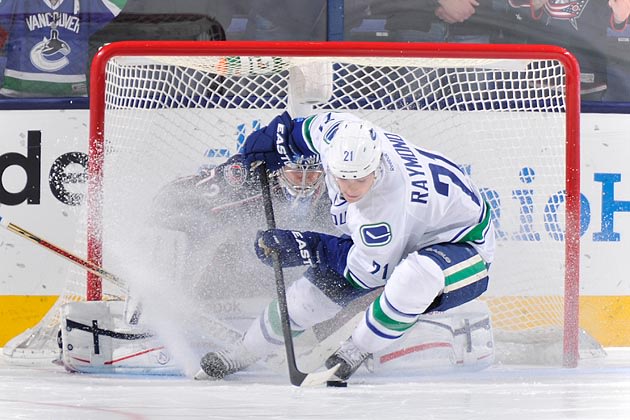
We’ve been debating its validity for years, and every month brings another moment of controversy, with Mason Raymond’s attempt against the Columbus Blue Jackets as the latest. Despite not exactly in keeping with the “puck moving forward at all times” thing, the NHL allows them as long as the move “involves continuous motion.”

Eliminate the spin-o-rama, and you eliminate a vast majority of the controversies we have in the shootout.
(But, again, the skills competition is such a ridiculous exercise in artifice that players should be able to shoot three pucks at the same time while firing a blow torch at the goalie’s face. You know, for entertainment’s sake.)

2. Hybrid Icing

For the uninitiated, this would transform icing into a race to the hash marks in the defensive zone; icing would be called as soon as the defensive player has the advantage – or is even – in the race to the end boards. No more shoves from behind or femur-shattering collisions at rink’s end.

It’s something that GMs like Steve Tambellini and especially Chuck Fletcher see as a common sense move, and it is: Hybrid icing helps prevent potentially catastrophic injuries while maintaining the visceral thrill of two players desperately chasing the puck. We’re still not sure how there’s opposition to that.

Speaking of icing …

3. Enough With Sneaky Delays of the Game

Every team knows how to earn its exhausted players some extra time to rest, whether it’s a goalie that needs an “equipment adjustment” or a player spending an extra second or 10 on the ice after an “injury.”

One trend in the NHL that’s been bugging me is on icing calls. It’s when teams empty their benches with players on a line change that legally can’t happen now that the defending team has iced the puck.

But rather than have five exhausted players immediately report to the faceoff dot near their goaltender to do the dance again, on-ice officials have to comb through a group of players to determine who needs to remain on the ice or back on the bench.

It’s a sneaky little move that I’ve seen employed by coaches like Peter Laviollette of the Philadelphia Flyers and Guy Boucher of the Tampa Bay Lightning, and has its roots in the mind of the late Roger Nielsen, that mad genius of rule-bending.

Defensive exhaustion leads to offensive chances. There’s no more established truth in hockey than that. So giving defensive players that extra time as this line change is sorted out is counter-intuitive to the icing rule that, frankly, is one of the better ones the NHL has passed.

Hit’em with a delay of game minor. Now we’re talking instant offense.

Of course, it doesn't stop there. As Jesse Spector noted on The Sporting News, teams are buying time in the faceoff dot as well by using wingers to take draws only to get tossed out of the circle:
“On every icing, the winger goes in (for the draw) and gets thrown out on purpose,” Islanders coach Jack Capuano said. “You see that everywhere you go. He’s getting thrown out so the center can take the draw and it buys five more seconds (after a team is not allowed to make a line change following an icing). That should be a rule that they should look at. That happens all the time. The officials, if they see something, a guy cheating once or twice, they’ve got to throw him out. I’ve got no problem with it.”
It's all a sneaky little delay.

Speaking of delay of game …

4. ‘Common Sense’ Puck Over The Glass

The moment I realized the “puck over the glass” delay of game penalty was idiotic was when I witnessed Matt Cooke of the Pittsburgh Penguins get a 2-minute minor after he shot the puck from his own end over the glass at the other end of the rink. Because, you know, that’s exactly where players are going to put the puck to delay the game. Yup.

Down Goes Brown picked apart this rule rather adeptly on Grantland, but came to the same conclusion I have:

The NHL wants more offense, but they can’t seem to figure out how to accomplish that at even strength. So why not add a nonsensical penalty that seems to have been specifically designed to create more power-play goals? Scoring goes up a little, everyone high-fives, and if we’re lucky nobody will mention that the rule is completely arbitrary and unfair.
In summary: It’s a rule that probably isn’t going to change, despite being awful, because it creates offense. And I’ve heard from enough coaches and GMs that are convince that it has actually decreased intentional pucks over the glass, whether or not that was an epidemic to begin with.

So if the rule isn’t going anywhere, let’s at least inject some common sense into the rule: Amend Rule 63.2 to give the referee some level of discretion on whether a player intentionally cleared the puck over the glass or simply misfired it.

We all see the games. We all know the difference. If you’re beef is that this turns referees into mind-readers … well, then we might as well take boarding majors away from them too.

5. Coach’s Challenge


As we’ve written this year: It’s beyond time for a limited coach’s challenge in the NHL. The technology is there to make reviews of plays efficient. The need is there for some check or balanced to be in place for game-changing calls like goalie interference on a scoring play or high-sticking double-minors in which one teammate cuts another.

As long as we limit them to one per game with consequences for teams that waste our time – a delay of the game minor, for example – they won’t become egregiously used.

What do you want to see the GMs recommend this week?

Tom Marshall: Chicharito's lack of minutes a worry for Mexico


Is Chicharito’s club situation at Manchester United good or bad for El Tri?

There has been an ongoing debate for some time now about striker Javier “Chicharito Hernandez’s situation at club side Manchester United that is worth bringing up ahead of Mexico’s crucial World Cup qualifiers against Honduras and the United States.

The fact is that Mexico’s number one forward has only played 63 minutes of soccer in March for the Red Devils, has only featured in three Premier League games in 2013 and was notably absent in both of those crucial Champions League games against Real Madrid.

As much as Sir Alex Ferguson heaps praise on the forward at every opportunity and that demanding a move from a club firmly established in the top echelon of European football would be premature, Hernandez’s situation is far from ideal.

This season, it is Manchester native Danny Welbeck that has stormed up the depth chart at Old Trafford ahead of Guadalajara’s finest and Robin Van Persie’s presence has been an unmovable obstacle to more minutes for Chicharito.

Whereas Chicharito watched from the bench in those games against Real Madrid, Welbeck was both starting and impacting the tie. But it wasn’t always that way. In the 2011 Champions League, Chicharito started the final against Barcelona, both quarters against Chelsea and one of the semifinal legs against Schalke.

With that in mind, it is difficult to argue that Chicharito has not slipped down the pecking order at Manchester United. 400 of his total 576 minutes of first team action in 2013 have come in the FA Cup. As much as Ferguson has stated the FA Cup is firmly on the agenda this season for United, there’s little doubt it paled in comparison to the Champions League when both were still on the table.

But there are two sides to this Chicharito debate from the Mexico national team point of view.

Would Mexico fans be happy if the player that has 28 goals in 44 appearances at a rate of one every 109 minutes for El Tri was being started by Ferguson twice a week? Combined with the long and difficult trip back over the Atlantic for national team duty, would we see the best of Chicharito for Mexico?

After all, Hernandez is training with top quality players on a daily basis and is still banging in the goals for Manchester United when he has been given the chance. In fact, Hernandez has netted six times in his eight appearances in 2013 at a rate of a goal every 96 minutes.

That considered, it could be argued that having a fresh Chicharito turning up well rested for crucial qualifying matches is a blessing in disguise.

The truth of the debate is probably lies somewhere in between both points of view. No national team coach wants a player showing up that is exhausted from overwork at club level, but having the nation’s star player come into two World Cup qualifiers having played just an hour’s football in the previous three weeks isn’t good either.

If Chicharito continues to get minimal minutes for Manchester United, it will eventually become a major worry for Chepo, if it isn’t already.


NFL passes helmet rule, ends tuck rule


PHOENIX (AP) -- NFL owners passed a player safety rule Wednesday barring ball carriers from using the crown of their helmets to make forcible contact with a defender in the open field.
Several coaches and team executives expressed concern about officiating the new rule, but Commissioner Roger Goodell championed it and it passed Wednesday as the owners meetings concluded.
Its passage by a 31-1 vote - Cincinnati voted no - was the second significant step in protecting defensive players; on Tuesday, the league took the peel-back block out of the game.
''There was a lot of discussion,'' Steelers President Art Rooney said of the helmet crown rule, ''but the way it was presented was the most effective way to address it.''
The tuck rule, one of the most criticized rules in pro football, was eliminated. Now, if a quarterback loses control of the ball before he has fully protected it after opting not to throw, it is a fumble.
Rooney said the Steelers were the only team to vote against getting rid of the tuck rule. New England and Washington abstained.
''We didn't think it was necessary to make that change,'' Rooney said. ''We were happy with the way it's been called.''
Video review now will be allowed on plays when a coach challenges even though he is not allowed to. But the coach will be penalized or lose a timeout, depending on when he threw the challenge flag.
That change stems from Houston's Thanksgiving victory over Detroit in which Lions coach Jim Schwartz challenged a touchdown run by the Texans' Justin Forsett. Although officials clearly missed Forsett being down by contact before breaking free on the 81-yard run, when Schwartz threw the red flag on a scoring play that automatically is reviewed, the referee could not go to replay.
That loophole has been eliminated.
Goodell was eager to get approved the competition committee's proposal to outlaw use of the crown of the helmet by ball carriers, and there was talk the vote would be tabled until May if the rule change didn't have enough support.
But after watching videos of the play that clearly showed the differences in legal and illegal moves by ball carriers, the owners voted yes -and then applauded the decision, something Rams coach Jeff Fisher said is ''rare.''
''We had discussions with the players association and the players themselves, the coaches' subcommittee,'' said Fisher, co-chairman of the competition committee. ''A lot of people talked to us about this rule and how to roll it out in our game.''
The penalty will be 15 yards from the spot of the foul, and if both the offensive and defensive player lowers his head and uses the crown of the helmet to make contact, each will be penalized.
''It'll certainly make our runners aware of what we expect relative to use of the helmet,'' Cowboys owner Jerry Jones said. ''One of the questions I ask a lot is who gains from this, offense or defense? And it's a toss-up as to which side of the ball has the advantage on this rule, if any. The main thing is it's pro-health and safety, and that's the big thing.''
The owners discussed simply using fines on ball carriers to eliminate the tactic, but instead voted to make the rule change.
''Jim Brown never lowered his head,'' Rooney said with a smile. ''It can be done.''

Tuesday, March 19, 2013

Kasey Kahne wins 1st career race at Bristol


BRISTOL, Tenn. (AP) -- Kasey Kahne's bumper-banging battle with Brad Keselowski was just the warm-up act in an action-packed race at Bristol Motor Speedway.
Former teammates Denny Hamlin and Joey Logano exchanged words after the race - in person and on Twitter - because Hamlin spun Logano as Logano was racing for the lead.
A flat tire knocked Jeff Gordon and Matt Kenseth out of the race while they were running 1-2.
Typical Bristol, right?
It looked that way as Kahne and Keselowski staged a spectacular battle for the lead, only for a caution to put them side-by-side for a restart with 39 laps to go.
Keselowski had an issue, he either spun his tires or the Hamlin-Logano feud disrupted his start, and Kahne sailed away for his first career victory at Bristol.
''Feels really good to win at this place,'' Kahne said. ''Such a tough track over the years. This is a big race for me. When you race in the Sprint Cup Series, Bristol is a race you want to win.''
Tempers flared after the race when Logano leaned inside Hamlin's window to complain about Hamlin spinning him as he tried to pass Gordon for the lead.
Logano was pulled away from Hamlin's car by crew members for both drivers in a classic post-Bristol clash that delighted the crowd. ''They're fighting! It's Bristol!'' yelled Clint Bowyer, who saw the action on the infield big screen.
Logano wouldn't discuss what he told Hamlin, but indicated there's no love lost between the former Joe Gibbs Racing teammates.
''That's a freaking genius behind the wheel of the 11 car - probably the worst teammate I've ever had,'' Logano said. ''I have a scorecard and I'm not putting up with that. What goes around, comes around. I had to put up with him for years, so whatever.''
Hamlin shrugged it all off.
''He said he was coming for me,'' Hamlin said. ''I usually don't see him, so it's usually not a factor.''
The two sparred briefly on Twitter after the season-opening Daytona 500, when Hamlin complained Logano ruined the closing laps of the race. But he said Sunday's flap was not a carryover.
''It didn't have anything to do with that,'' Hamlin said. ''You've really got to control your car and he slipped up into me. Really, he would have been in the garage with no radiator in it if I had not checked up twice. I meant to run in to him. I didn't mean to spin him out, but his day was fine. We finished bad and he finished bad. It's even.''
But they continued sniping at each other after the race on Twitter, overshadowing what was undoubtedly the best race to date for NASCAR's new Gen-6 race car.
And, their feuding may have played a role in the outcome of the race, too.
Keselowski was the leader on the final restart as he lined up next to Kahne. Hamlin was lined up behind Keselowski, with Logano lined up behind Hamlin. When the flag waved, Keselowski didn't go and Kahne rocketed to the lead and never looked back.
Although it appeared Keselowski spun his tires, he was adamant after the race about what happened - ''I got ran over!'' - and that prevented him from breaking away on the restart.
Hamlin backed up Keselowski's account.
''The 22 (Logano) ran into me and shoved me into (Keselowski),'' Hamlin said. ''Sorry to the 2, but I was the pinball in the sandwich. Once he throttled up, the 22 lifted me up and just flat out pinned me up against the 2.''
Logano seemed to think Keselowski spun his tires and that created the bottleneck, but Keselowski believed he had help from behind.
''I haven't seen the replay, I just know my rear tires were off the ground before I got to the restart zone,'' he said. ''Eventually I got hit so hard it pushed my foot in the gas pedal, made myself look like a (fool). That was the deal. Never had another chance.''
Nobody came close to Kahne, who drove his Hendrick Motorsports Chevrolet to the win by 1.7-seconds. Hendrick drivers have now won two of the first four races this season.
Kyle Busch snagged second from Keselowski, who took over the Sprint Cup Series points lead as the only driver to open the season with four top-five finishes. Kurt Busch finished fourth and was followed by Bowyer and Dale Earnhardt Jr.
Ryan Newman was seventh, Brian Vickers was eighth and Paul Menard and Jamie McMurray rounded out the top 10.
The race changed dramatically with 110 laps to go in a bizarre crash between leaders Gordon and Matt Kenseth. Gordon was out front when he suddenly lost a tire and his car darted up the track into the wall.
Kenseth had nowhere to go to avoid him and drove directly into the back of Gordon, causing heavy damage to both cars.
''You all right?'' crew chief Alan Gustafson radioed Gordon.
''Yeah, I'm OK. Did we take out Matt, too?'' Gordon asked.
With the top two cars in the garage, the rest of the field headed to pit road to reset for the final 100 laps.
''I hate that for Matt Kenseth,'' Gordon said. ''He was coming, and it was just a matter of time before he caught us. We needed points. This definitely isn't going to get us many.''
Kenseth, winner of last week's race at Las Vegas, said the crash was unavoidable.
''There's not a lot either one of us can do about that,'' he said. ''There was nowhere to go.''
Before the Gordon-Kenseth crash, Gordon and Logano were dueling for the lead. Gordon used a two-tire stop with about 175 laps to go to gain eight spots on pit road and take the lead. Logano chased Gordon around the 0.533-mile bullring, pulling even with the four-time champion as he exited the corners only to lose ground on the straights.
Lurking behind in third was Hamlin, who apparently got tired of waiting for Logano to get past Gordon and showed how restless he was with slight contact on Logano's bumper as they exited Turn 2.
The tap caused Logano to back his car into the wall and took him out of contention, leading to the post-race drama Bristol is known to create.


All aboard: NHL GM meetings will focus on boarding embellishment, icing alternatives


Getty Images 


When the NHL’s general managers meet this week in Toronto, they’ll engage in a discussion of what works and what needs fixing. Which is to say, a discussion of what you can fix and what might just be engrained, systemic problems in this gloriously violent sport of ours.
Some of it will focus on the boards surrounding the ice: Points of impact that can severely injure a player, in a broken bones or paralysis way, depending on the force being delivered by an opponent or the awkward way that player crashes into them.
Icing plays, for example, have always been at the forefront of “preventable” problems. That’s why modified icing was tested at the NHL’s Research and Development Camp in the last few years, and why hybrid icing was tested in the American Hockey League this season.
From the New York Times, we learn that icing will be on the agenda for Wednesday’s meeting:
The American Hockey League tried hybrid icing for 564 games during the lockout, calling it “positive.”
The dangers of high-speed chases to the end of the rink were recently highlighted by a horrific accident in the Swiss B League that left a 33-year-old defenseman, Ronny Keller, paralyzed. It was not an icing chase, but it resembled one, as Keller and a pursuing forward raced after a puck from red line to goal line and collided, sending Keller hurtling headfirst into the corner boards.
“I formed my opinion before that injury to the Swiss player — I’ve seen enough injuries related to the race for the puck,” [Carolina GM Jim] Rutherford said. “I like the hybrid icing, and I’d suppose we’ll be talking about it at the meeting.”
Is there enough traction for that rule to pass? Tough to say. These things seem to ebb and flow in popularity depending on when, and how gruesome, the latest injury was. All due respect to Keller, but he doesn’t play in the NHL, and that’s where the attention of the GMs and the Board of Governors is focused.
While icing injuries could be preventable, something else along the board may not be: Embellishment to gain boarding calls.

On Hockey Night In Canada, Glenn Healy offered the following take on embellishment:
Kevin Weekes dropping the European football comparison to NHL divers. Yowch.
Players turning their numbers to draw calls is, at this point, an epidemic.
Of course, it’s also the NHL’s own doing: When you fortify your rulebook and deputize your officials to target hits from behind, then players are going to do whatever it takes to draw penalties for hits from behind.
It’s the same reason why a total ban on contact with the head would never work – players would skate with their heads down more than Lindros did to draw calls. You’d see more shoe-gazing in the NHL than at a My Bloody Valentine concert.
The problem is that outside of referees determining, in a millisecond, the intent of the player being hit, there’s no eradicating embellishment along the boards, is there?
Do you dial back the rules on boarding? Sure, if you’re someone that’s keen on the NHL getting sued by crippled ex-players for putting them at greater risk by making the game less safe.
Do you adopt nonsense like the Brian Burke Bear Hug rule, in which player safety concerns usher in an era of legalized holding and obstruction in the offensive zone? Of course not. Because that’s always been a stupid solution to a practically unsolvable problem.
Embellishment is a tactic, whether it’s drawing a call in the slot or the neutral zone or along the boards. Yes, in a pristine world of sportsmanship and integrity, no one would dive or take advantage of the rules. Alas, the NHL is not, nor has ever been, that world.
So the GMs will talk about it, mull it over, demonize it to the media … and then do nothing about the embellishment each of their teams engage in.
Short of the NHL retroactively fining players for embellishment – like when you get a speeding ticket via a robotic camera on I-95 – it’s one of hockey’s engrained, systemic problems.

Monday, March 18, 2013

Tinordi sets up winner for Montreal in NHL debut


Series at a Glance

  1. Game 1: Canceled
    Montreal0
    @ New Jersey0
  2. Game 2: Final
    New Jersey3
    @ Montreal4
    Final
  3. Game 3: Final
    Montreal2
    @ New Jersey1
    Final
  4. Game 4: Tue, Apr 23 7:00 PM ET
    Montreal
    @ New Jersey


NEWARK, N.J. (AP) -- Things are going so well for the Montreal Canadiens that even the kids they are bringing up from the minor leagues are contributing.
Making his NHL debut, big defenseman Jarred Tinordi set up Tomas Plekanec's tiebreaking goal in the third period, and the Canadiens extended their winning streak to five games with a 2-1 victory over the New Jersey Devils on Saturday night.
''What a start for the kid,'' Canadiens coach Michel Therrien said of the 20-year-old son of former NHL defenseman Mark Tinordi. ''We're all pleased with the way he played the puck at net. It looked routine out there for him.
''He showed a lot of poise for his age and played very solid. He wasn't nervous. He saw more ice time because you can see him become more comfortable. He made the right decisions.''
The best decision by Jarred Tinordi was understanding that goalie Johan Hedberg's clearing pass from behind the net took a bad bounce off the sideboards and was heading to open ice above the left circle. The 6-foot-6 Tinordi skated toward the puck from the right side and let go a shot that Plekanec deflected past Hedberg at 6:49.
''I felt pretty comfortable out there,'' said Tinordi, who played 19 shifts and almost 15 minutes just two days after being called up from Hamilton. ''I think the nervousness and the butterflies were gone after the first couple of shifts.
''I tried not to think about the way I was playing. I knew we scored on the play. I didn't realize I got an assist. The boys were pretty happy for me. I was just shooting it to get it on net.''
Hedberg said the goal was the type one would expect to decide a tight-checking game.
'We make that play 20 times a game, and sometimes the puck doesn't want to go your way,'' said Hedberg, who finished with 20 saves. ''It came back to them and boom boom, it's in the net. It was one of those games that comes down to a goal like that, and we were weren't fortunate enough to get it.''
Colby Armstrong also scored for Montreal, and Carey Price made 32 saves. The Canadiens moved into a tie with Pittsburgh for the most points in the Eastern Conference.
Defenseman Peter Harrold scored for New Jersey, which lost for the second time in two nights (0-1-1).
''It's a tough one to swallow, but their goalie played well and so did ours,'' Devils forward Ilya Kovalchuk said.
Price was just a little bit better in making Plekanec's 12th goal of the season stand up. He stopped 18 shots in the third period, including a chest save through traffic on Patrik Elias with 1:24 left and stoning Adam Henrique and Travis Zajac in close in the final minute.
''They put a little bit of a full-court press on us, but our guys battled hard all night,'' Price said. ''We're working hard every night, trying to keep things simple. I think that's the style of play we have to have. We have good teamwork and that's what's working for us.
''I think our team is excellent in coming back after I make a save, collapsing on everything I leave out there, cleaning up the trash. We're sticking to the game plan and that makes it a lot easier.''
Playing for the third time in four nights, the Devils tied it 1-1 on Harrold's power-play goal at 3:54 of the second period.
With Ryan White off for holding the stick, Kovalchuk intercepted a clearing pass at the right point and slid the puck across the ice to Harrold. The defenseman got a shot off quickly and squeezed it between Price's pads for his first goal since Dec. 2, 2010 - a span of only 26 games for the journeyman, who has spent much of his career in the minor leagues.
Armstrong snapped a 39-game goal drought, dating to February 2012, to give the Canadiens the lead at 8:08 of the first period.
Devils defenseman Anton Volchenkov lost his footing shortly after a faceoff. Armstrong retrieved the puck, skated into the right circle and ripped a shot past Hedberg, who made his career-high 12 straight start in place of the injured Martin Brodeur.
Forward Mike Blunden, who grabbed an early-morning flight after being recalled from Hamilton, appeared to screen Hedberg on the play.
''You have to like the way the young guys played,'' Canadiens captain Brian Gionta said. ''They came through.''
Goal posts kept both teams from taking the lead during the same second-period penalty. Kovalchuk, who leads the NHL with four short-handed goals, just missed another on a 2-on-1 break while Harrold was in the penalty box.
Lars Eller beat Hedberg about a minute later, but that puck also struck a post.
NOTES: The Canadiens have scored first in 21 of 28 games. ... Montreal RW Michael Ryder had his streak of 114 consecutive games played snapped because of a lower body injury. He last missed a game in March 2011. ... Devils C Andrei Loktionov, who was hurt Friday against Philadelphia, sat out due to an undisclosed injury. ... C Harri Pesonen made his NHL debut for New Jersey. .. Harrold was cut badly on the forehead by a shot in the third period, but returned to the game. ... The Devils honored former goalie coach Jacques Caron before the game.


Former Okla QB Steve Davis dead at 60


NORMAN, Okla. (AP) -- As a child, Steve Davis dreamed of playing for Oklahoma and even tucked away a picture of the Sooners' quarterback he idolized in his dresser drawer.
Decades later, he is among the standard-bearers for the position at one of college football's most storied programs. Davis, who started every game during Barry Switzer's first three seasons as head coach and won national championships in 1974 and 1975, died Sunday in a plane crash in South Bend, Ind. He was 60.
Davis compiled a remarkable 32-1-1 record as the Sooners' starter from 1973 to 1975. The Sooners went 11-0 in 1974, then won the national title again the following year after going 11-1.
It was a storybook career for Davis, who finished with one of the best records for a starting quarterback in the sport's history after a humble beginning at Oklahoma. He grew up in Sallisaw in the eastern part of the state and developed a love for the Sooners. In an interview with The Oklahoman newspaper last year, he described how he hid a picture from an Oklahoma football brochure in his top dresser drawer.
''It was a shot into the huddle, and there was Bobby Warmack, who was my idol. He had that eye-black, and the double chin strap and the towel out of the front of his pants,'' Davis told the paper. ''I took that picture, and I took a big, black magic marker and wrote ''WHEN?''
The day Davis made his first start in the 1973 season opener, he said, his mother took the picture and wrote on it: ''TONIGHT.''
Oklahoma beat Baylor in the opener, then tied powerhouse Southern Cal - with Lynn Swann and Pat Haden - in the second game.
After that, Davis and the Sooners ran off 28 straight victories.
''I will never get away from the fact that I was an Oklahoma quarterback. I will never get away from the fact that I only lost one game,'' Davis said in the 2008 book ''The Die-Hard Fan's Guide to Sooner Football.'' ''All of those things are a part of my legacy and my history. I am very thankful for what happened. I don't know that I would trade my career for any other quarterback that has ever played at OU.''
A product of a different era, Davis hardly had to throw a pass to be the star quarterback in Oklahoma's dominant wishbone offense. He completed just 40 percent of his passes during his career for 2,034 yards, but only attempted about six passes per game during Oklahoma's back-to-back championship seasons.
With silver-shoed All-American Joe Washington carrying the ball, the Sooners rushed 813 times in 1974 - averaging an NCAA record 73.9 attempts per game - and amassing 438.8 yards on the ground. Davis' school records for consecutive starts (34) and career victories (32) were surpassed only last season by Landry Jones, who started every game the past three seasons plus most of 2009 while replacing injured Heisman Trophy winner Sam Bradford.
In the process, Davis reached out to Jones, who had been criticized after an early season loss to Kansas State by writing him a letter; Davis had been booed during the only loss of his career, a 23-3 setback to Kansas in 1975. Jones would go on to break Davis' career record for wins by beating Texas, also joining Davis, Jimmy Harris and Jamelle Holieway as the only Sooners' quarterbacks to go 3-0 in Red River Rivalry starts.
''He just really wanted to encourage me,'' Jones said. ''Just keep going, keep leading those guys and keep fighting, regardless of what happens in the next game or the last game. Your focus is on this game and always to lead those guys.''
Davis said his parents were from Sallisaw, though he was born at Barksdale Air Force Base in Bossier City, La., where his father was stationed. He received the very last available scholarship to play at Oklahoma - only after another player had decided to play at Colorado instead, according to the 2012 book ''I Love Oklahoma/I Hate Texas.''
''They had a lot of scholarships and they recruited eight quarterbacks to try to find somebody that could imitate Jack Mildren, and I was one of those eight,'' Davis recalled in the ''Fan's Guide'' interview. ''I was the bottom of the eight but I was one of those eight, and through early fall drills I started out as number eight quarterback.''
Davis described how he considered leaving Oklahoma before the 1973 season, but instead dedicated himself to competing and ended up landing the starter's job after Kerry Jackson was suspended and the Sooners were put on probation.
It would end up being among the greatest tenures for a starting quarterback in Oklahoma history, along with Harris' performance during the NCAA record run of 47 consecutive victories.
''That's what you live for,'' Davis said in the ''Fan's Guide'' interview. ''I never felt nervous or anxious. I mean, I just couldn't wait to get out there and go play, go match up, go see who's better. I never got tight. I was an excitable player, but I think I played within myself, and just knowing I was going to go compete in front of 70,000 or 80,000 people and go find out who's best - it was great.''

Friday, March 15, 2013

NASCAR overpolicing in case of Denny Hamlin?


CHARLOTTE, N.C. (AP) -- What a great NASCAR race that was at Las Vegas! The new Gen-6 car sure put on an amazing show, one for the ages, for sure.
That's the kind of effusive praise we should expect to hear from drivers the rest of the year, right?
Anything short of that could lead to another shut-up-and-drive fine like the one levied last week against Denny Hamlin, who was popped for $25,000 for having the audacity to give an honest answer when asked to assess NASCAR's new car after its second race.
Hamlin is digging in his heels for this fight, though, saying he'll be suspended before he'll pay the fine. In reality, he'll first go through an appeals process, and if NASCAR is smart, it will quietly make this whole mess go away.
NASCAR claims Hamlin committed one of those heinous ''actions detrimental to stock car racing'' when he politely summed up the afternoon at Phoenix with this scathing assessment: ''I don't want to be the pessimist, but it did not race as good as our generation five cars. This is more like what the generation five was at the beginning.''
Many fans remember what the generation five - known as the ''Car of Tomorrow'' - was at the beginning because Kyle Busch notoriously trashed it in Victory Lane after winning its debut race. Not wanting this new car to gain the same reputation, NASCAR apparently took a strong stand against Hamlin because it will not permit its drivers to ''denigrate the racing product.''
Only Hamlin wasn't trashing the racing, or the new car. He was asked for his opinion about the performance of the car after two races - and he told the truth.
Now he's been punished by a hypersensitive NASCAR that likely did more harm than good with the fine.
Why? Because in overpolicing the brand, NASCAR offended its fan base. People who never rooted for Hamlin before now firmly back the driver and his right to speak his mind. Hamlin was, after all, only saying what they were all thinking.
Everyone can understand that NASCAR is trying to avoid a repeat of the disastrous CoT. It never had a chance after Busch's tongue-lashing, and NASCAR spent all of last season developing the Gen-6 car to put the CoT out to pasture once and for all.
Only Busch didn't ruin the CoT for fans. They didn't need a driver to tell them the car was ugly or drove like a milk truck. They had eyes. They could see for themselves they hated everything about the car, including the on-track racing.
Now there's a new car this season, with a finely tuned marketing strategy and a serious messaging plan.
Straying from the script, as Hamlin learned, won't be tolerated by NASCAR.
Nor will taking the fans for idiots.
The backlash against NASCAR over Hamlin's fine included signs of ''Free Denny'' at Las Vegas Motor Speedway, and the hashtag (hash)StandWithDenny formed on Twitter as a riff on the (hash)StandWithRand from Sen. Rand Paul's filibuster a day earlier.
This is because fans watched the same two races Hamlin did to start the season. They saw the Daytona 500 was mostly a single-file parade until the late push to the checkered flag, and the race at Phoenix a week later had 445 fewer green-flag passes than last November's race there with the old car.
And the fans remembered that NASCAR chairman Brian France was asked in January how success will be measured with the Gen-6 car.
''I think we'll measure it by lead changes, we'll measure it by how it races, we'll measure it by how the drivers feel about it,'' France said.
We know how Hamlin felt about it, and he got his hand slapped. So how in the world will anyone believe anything the drivers say going forward? Why would they dare say anything even borderline critical?
Hamlin's comment was fairly mild. All he said was the car in its present form needs more work, that after two races it's not as good as where the old car was after six years.
Well, no kidding. The Gen-6 has been overhyped from the beginning, and NASCAR has backed itself into a corner by essentially guaranteeing the racing will be better this year. Eventually, it might. But to believe anyone at NASCAR was going to snap their fingers and roll out a magical new car capable of producing the most exciting races ever seen is ludicrous.
It's all a work in progress and it should be noted that the third race for the new car was better than the first two. According to NASCAR statistics that began in 2005, Sunday's race at Las Vegas had a record 31 green flag passes for the lead, and the 2,342 passes on the track under green was more than 1,000 over last year's race.
Maybe that makes for a better race, maybe not. That's for the fans to decide, based on what they see on the track and what they hear from the drivers. They don't need the drivers to tell them things are great if they aren't, and, as NASCAR learned, they'll quickly resent being force-fed anything but the cold, hard truth.